A handy device, a few flashes of light in front of the television, and the hair disappears – just like in a clinic, only cheaper. That, or something similar, is how IPL and laser home devices are often advertised. They do indeed work on the same physical principle as professional devices. But the same principle does not mean the same effect. What the studies show, where the differences lie and why your eyes are the biggest issue – that is the subject of the fourth part of our series “Laser myths checked”. We deliberately do not name any brands.
What many people believe
The idea is understandable: if a device is called “laser” or “IPL”, it should work as it does in a clinic. On top of that, many home devices are approved or certified. That is quickly taken as proof of equal effectiveness. Yet a product safety mark says little about how well a device reduces hair.
Two types of device, one principle
Most home devices for hair removal are IPL devices. IPL stands for “intense pulsed light”. Unlike a laser, a flash lamp emits a broad spectrum of many wavelengths, which is narrowed down by filters. There are also home devices with a diode laser. Both rely on the same target: melanin in the hair absorbs the light, heats up and damages the hair root. How this works in detail is explained on the page How lasers work.
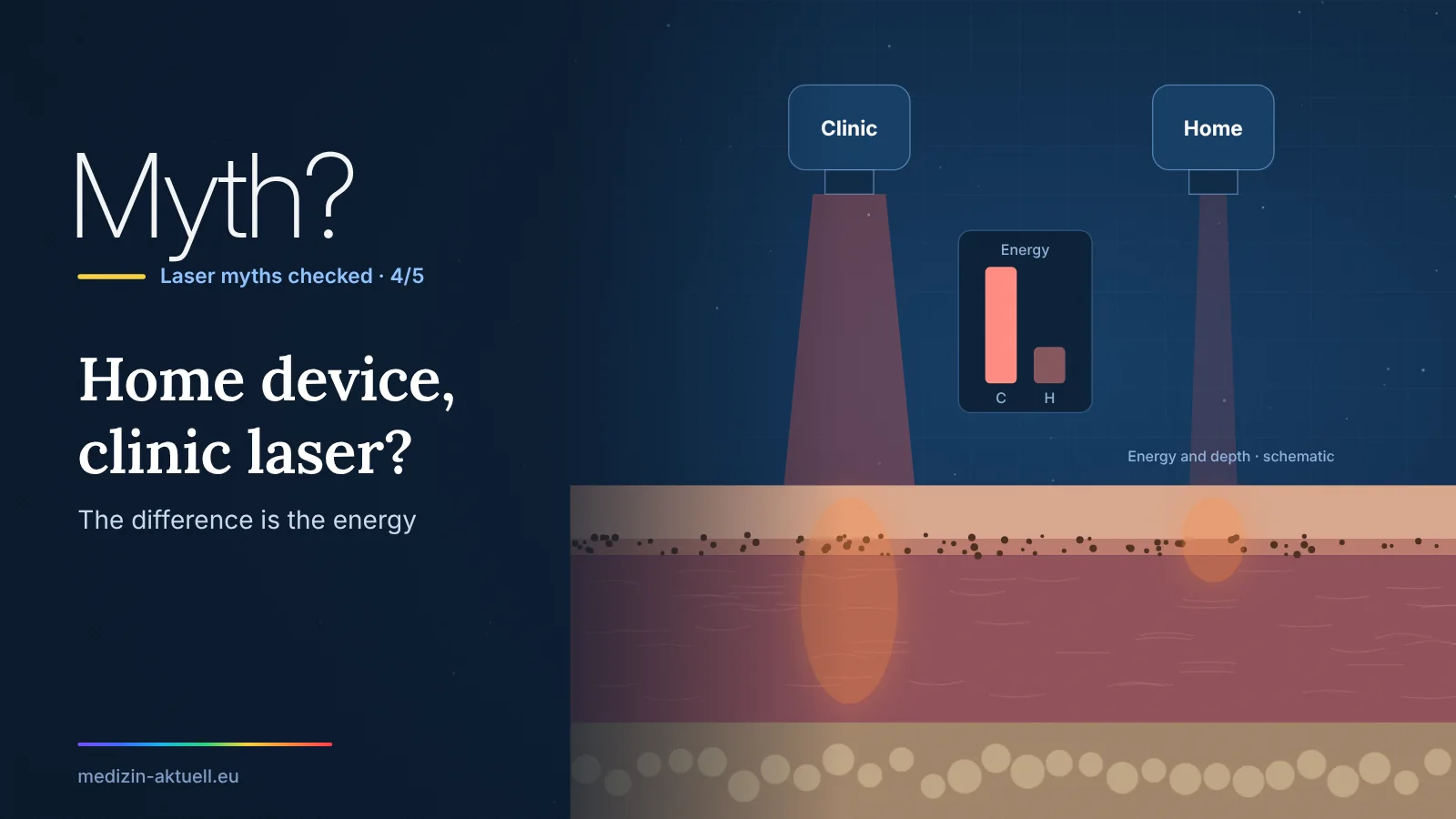
The difference lies in the energy
Germany’s Federal Office for Radiation Protection (BfS) states that home devices usually reach a lower energy density than devices in clinics and salons. That is intentional, because lay people without training operate them. Less energy lowers the risk but can also reduce the effect. At the same time, BfS experts stress that to achieve any effect at all, home devices too must exceed the exposure limits for skin and eyes. A completely risk-free device that still works therefore cannot exist.
Not all home devices are weak. According to the BfS, some contain lasers of class 3B or 4. These classes are considered hazardous to the eye.
What the studies show
A systematic review published in the Journal of the European Academy of Dermatology and Venereology in 2012 analysed the available studies on light-based home devices. It found seven studies: one controlled and six without a control group. There were no randomised trials. Most of the data concerned IPL devices; for home lasers there was only one study. After repeated use, hair reduction of between 6 and 72 per cent was observed, mostly up to three or six months after the last use. The authors speak of short-term effectiveness and call for controlled trials.
For comparison: for professional devices, a Cochrane review found a reduction of about 50 per cent up to six months after treatment with alexandrite and diode lasers. Long-term data are lacking there too, as we showed in Part 1 of this series. A direct, fair comparison of home and professional devices in large studies is still largely missing. The wide range of results for home devices does show, however, that it is hard to predict whether and how well they will work.
Eyes: the underestimated risk
No eye damage was reported in the review mentioned above. The authors nevertheless regard it as a theoretical risk that small studies can hardly capture. Experience from clinics shows how serious eye injuries can be: an analysis of 21 case reports found that hair removal around the eyes was the most frequent cause. Closed eyelids do not protect reliably.
The BfS lists possible consequences such as corneal injury, damage to the retina, clouding of the lens and changes to the iris. A manufacturer’s note quoted by the BfS therefore explicitly excludes the eye area. Many devices have a sensor that only fires when in contact with the skin. The BfS points out, however, that such sensors do not prevent effects on the skin. The Swiss Federal Office of Public Health (FOPH) recommends suitable protective goggles even with home IPL devices and notes that these are often not supplied.
Skin, pigment and what nobody checks at home
In the review, redness was the most common side effect. Swelling, blisters, crusting and pigment changes also occurred. The BfS lists contraindications in which home devices should not be used, such as skin cancer, many moles, chronic skin diseases, sensitivity to light, very dark skin or photosensitising medicines. Tattoos should explicitly never be treated with a home device.
In a clinic, a trained professional first checks whether a dark spot is harmless and whether skin and hair type are suitable. At home, this step is missing. That is particularly delicate with pigment spots, as Part 2 of this series shows. The NiSV only applies to commercial use. For private use there is no requirement for expertise – what is mandatory in clinics and salons is explained on the page Laser safety: who may treat?.
What this means for you
- Expect maintenance or a weaker reduction from a home device rather than a clinic result. The evidence is thin.
- Never use it on the face near the eyes. Wear goggles that match the wavelength, even if none are included.
- Do not use it on moles, pigment spots, tattoos or tanned skin.
- Have new or changing dark spots examined by a doctor first.
- Seek medical help if you have blisters, persistent redness, visual disturbances or eye pain.
Frequently asked questions
Are IPL home devices real lasers?
No. IPL devices emit broadband flash light, whereas lasers emit light of a single wavelength. Both use melanin in the hair as the target. There are also home devices with a diode laser.
Why are home devices weaker?
Because they are operated by lay people without training. The lower energy density is meant to reduce the risk but can also reduce the effect.
Is it enough if the device only fires on skin contact?
No. According to the BfS, such a sensor does not prevent skin damage. For the eyes, the Swiss FOPH recommends suitable protective goggles even with home devices.
Can I remove a tattoo with a home device?
No. Tattoo removal needs very short pulses from special lasers and in Germany is reserved for doctors. More on this in Part 5 of this series.
Series “Laser myths checked”: Back to Part 3: “Never have laser treatment in summer” · Part 4: “Home devices work just like clinic lasers” (this article) · Continue to Part 5: “Tattoos can be lasered off completely”
More laser series: History of the laser · Lasers & AI
Read more: Laser medicine overview · How lasers work · Laser safety: who may treat? · Treatment companion
General information, not a substitute for medical advice.
Sources
- Federal Office for Radiation Protection (BfS): Epilation – Professional and home use
- Asmuß M, Weiskopf D (BfS): Laser, IPL & Co – Applications of optical radiation for cosmetic purposes. UMID 1/2016, pp. 11–17 (in German)
- Asmuß M (Federal Office for Radiation Protection): Anwendung optischer Strahlung am Menschen zu kosmetischen Zwecken (presentation, BfR; in German)
- Thaysen-Petersen D, Bjerring P, Dierickx C, Nash JF, Town G, Haedersdal M: A systematic review of light-based home-use devices for hair removal and considerations on human safety. J Eur Acad Dermatol Venereol 26(5), 545–553 (2012)
- Haedersdal M, Gøtzsche PC: Laser and photoepilation for unwanted hair growth. Cochrane Database of Systematic Reviews (2006), CD004684
- Huang A, Phillips A, Adar T, Hui A: Ocular Injury in Cosmetic Laser Treatments of the Face. J Clin Aesthet Dermatol 11(2), 15–18 (2018)
- Swiss Federal Office of Public Health (FOPH/BAG): Behandlungen mit Laser und IPL – So schützen Sie sich (in German)
- NiSV Section 1: scope (gesetze-im-internet.de; in German)


Leave a Reply