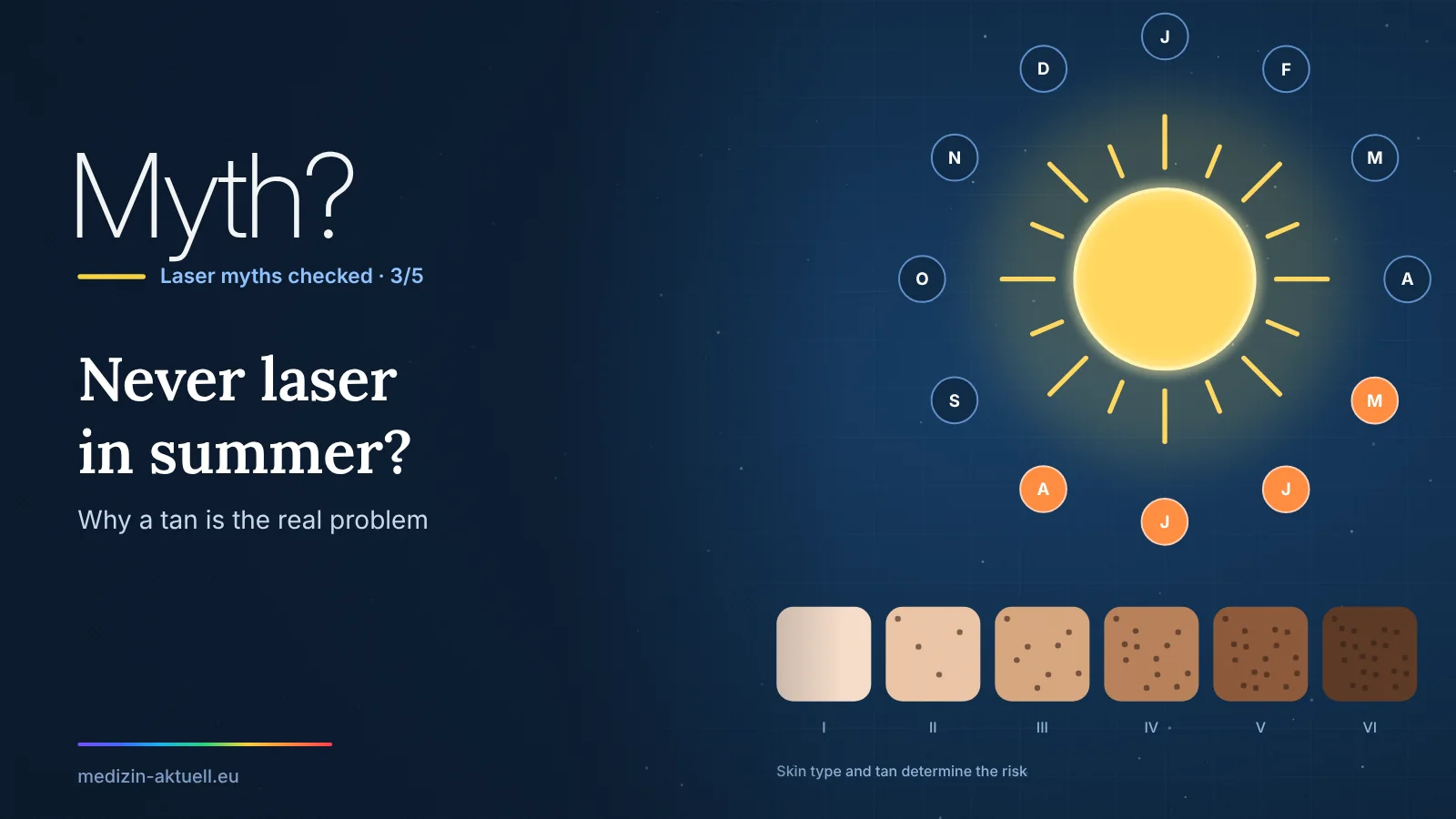
As soon as temperatures rise, the same sentence can be heard in many waiting rooms: “No laser treatment in summer.” Some people therefore postpone every treatment until autumn; others think the rule is excessive caution. The truth lies in between. The problem is not the calendar but the tan – and that only matters for certain procedures. Part 3 of our series “Laser myths checked”.
What many people believe
The rule sounds simple: summer means sun, sun means risk, so no laser from May to September. Behind it lies a correct observation. Many side effects of skin lasers are linked to sunlight. But a justified caution has turned into a blanket ban that is not accurate as it stands. It fits neither all lasers nor all people.
Why a tan is the real problem
Many skin lasers act on a particular pigment, such as melanin in hair and pigment spots. But melanin also sits in the outer layer of the skin. If you are tanned, you have more of it there. The laser light is then absorbed not only in the target but also in the outer skin. The result can be burns, blisters and light or dark patches.
Germany’s Federal Office for Radiation Protection (BfS) describes this link explicitly. A higher melanin content increases the risk of side effects, whether the tan comes from the sun or a sunbed. The skin should therefore ideally not be tanned before treatment. The Swiss Federal Office of Public Health (FOPH) lists recent sun exposure and heavily tanned skin as reasons not to treat. Quite apart from lasers: the International Agency for Research on Cancer (IARC) classifies UV radiation as carcinogenic. Sun protection therefore pays off twice.
What the guideline actually says
The German guideline on laser therapy of the skin (AWMF 013-095) is very specific about pigment treatments:
- UV radiation from the sun and sunbeds should be avoided for around four weeks before and after treatment.
- Protection should come from clothing or sunscreen with SPF 50+.
- Immediately after treatment, sunscreen with a UVA filter is important to prevent dark patches after inflammation. Specialists call this post-inflammatory hyperpigmentation.
- Heavily tanned skin should not be treated because of the risk of light patches.
- For melasma, a patchy pigment disorder of the face, the guideline advises against treatment in summer. UV light can trigger a relapse, which is then wrongly blamed on the laser.
The FOPH adds practical points: irritating or photosensitising products such as fruit acids or retinoids should be stopped about a week beforehand. Afterwards: avoid the sun, use SPF 50+ and stay away from saunas or steam rooms for 48 hours.
By procedure: where the myth holds and where it does not
Hair removal: a tan is particularly important here because melanin is the target. For darker skin, professional bodies recommend longer wavelengths. The Endocrine Society’s guideline names long-pulse Nd:YAG or diode lasers with skin cooling for people with darker skin. In a talk at the annual meeting of the American Society for Laser Medicine and Surgery (ASLMS), the 1064-nanometre Nd:YAG laser was described as the preferred choice for very dark skin. That does not mean, however, that freshly tanned skin can be treated without a second thought.
Pigment spots and melasma: here summer really is unfavourable, because UV light stimulates new pigmentation and can undo the result.
Vessels and scars: after vascular or scar treatments, too, the skin is more sensitive. Consistent sun protection is part of the deal. Whether treatment in summer makes sense depends on your skin type, the treatment site and your daily life. There is more on the pages Vascular laser and Laser scar treatment.
Tattoo removal: the skin is injured and needs time to heal. Tanned skin increases the risk of pigment changes here too. More on this in Part 5 of this series.
Lasers that do not act on tanned skin: many lasers do not work on the skin surface at all. In laser eye surgery, in dentistry, for stones and the prostate or when treating varicose veins from the inside, a tan makes no difference to how the laser works. Which rules apply after the procedure, for example on sun, heat or exercise, is set by the treating practice.
What this means for you
- Do not ask “Is it summer?” but “Is the skin in the treatment area tanned, and will I reliably avoid the sun over the coming weeks?”
- For hair removal and pigment treatments, starting in autumn or winter is often more practical, because it is easier to avoid the sun then.
- Areas that stay covered anyway can sometimes be treated in summer too – after a medical assessment.
- Do not turn up to your appointment with a fresh tan or sunburn. Say openly if you have recently been in the sun or on a sunbed.
- A checklist for preparation and aftercare can be found in the Treatment companion.
Frequently asked questions
Can I have laser treatment in summer at all?
Depending on the procedure and body area, yes. What matters is that the skin in the treatment area is not tanned and that you consistently avoid the sun before and afterwards. For pigment disorders such as melasma, the guideline advises against summer.
How long before and after treatment should I avoid the sun?
For pigment treatments, the AWMF guideline gives around four weeks before and after. For other procedures the period may differ; the exact instructions come from the treating practice.
Is sunscreen enough?
It is important, but it does not replace avoiding the sun. The guideline recommends clothing or SPF 50+ with UVA protection.
Does the summer rule also apply to laser eye surgery?
Skin tan plays no role in laser eye surgery. Which instructions apply after the procedure, for example on protecting the eyes, is explained by the treating practice.
Series “Laser myths checked”: Back to Part 2: “Lasers cause cancer” · Part 3: “Never have laser treatment in summer” (this article) · Continue to Part 4: “Home devices work just like clinic lasers”
More laser series: History of the laser · Lasers & AI
Read more: Laser medicine overview · Treatment companion · Vascular laser · Laser safety: who may treat?
General information, not a substitute for medical advice.
Sources
- AWMF guideline 013-095: S2k guideline laser therapy of the skin (as of 11 Jan 2022, valid until 10 Jan 2027; in German)
- Asmuß M, Weiskopf D (BfS): Laser, IPL & Co – Applications of optical radiation for cosmetic purposes. UMID 1/2016, pp. 11–17 (in German)
- Swiss Federal Office of Public Health (FOPH/BAG): Behandlungen mit Laser und IPL – So schützen Sie sich (in German)
- Endocrine Society: Evaluation and Treatment of Hirsutism in Premenopausal Women – Clinical Practice Guideline (2018)
- MDedge: ASLMS – Tips for effective laser hair removal in darker skin (report from the ASLMS annual meeting, 5 May 2010)
- ecancer: UV tanning beds and UV radiation moved up to highest cancer risk category by IARC (29 July 2009)

Leave a Reply