A name that no longer fits, a design from your youth, a tattoo that gets in the way at a job interview: there are many reasons for removal. And often there is also the expectation that the laser will simply “rub out” the picture as if it had never been there. Modern lasers really can lighten tattoos considerably. How much depends on the colours, depth, skin type and body area, however – and complete removal cannot be promised. In the final part of our series “Laser myths checked”, we put into perspective what is realistic.
What many people believe
Many people imagine tattoo removal as being like deleting a file: a few appointments and the skin is as it was before. Before-and-after pictures on the internet reinforce this impression. But they mostly show selected cases that went especially well. Reality is more varied.
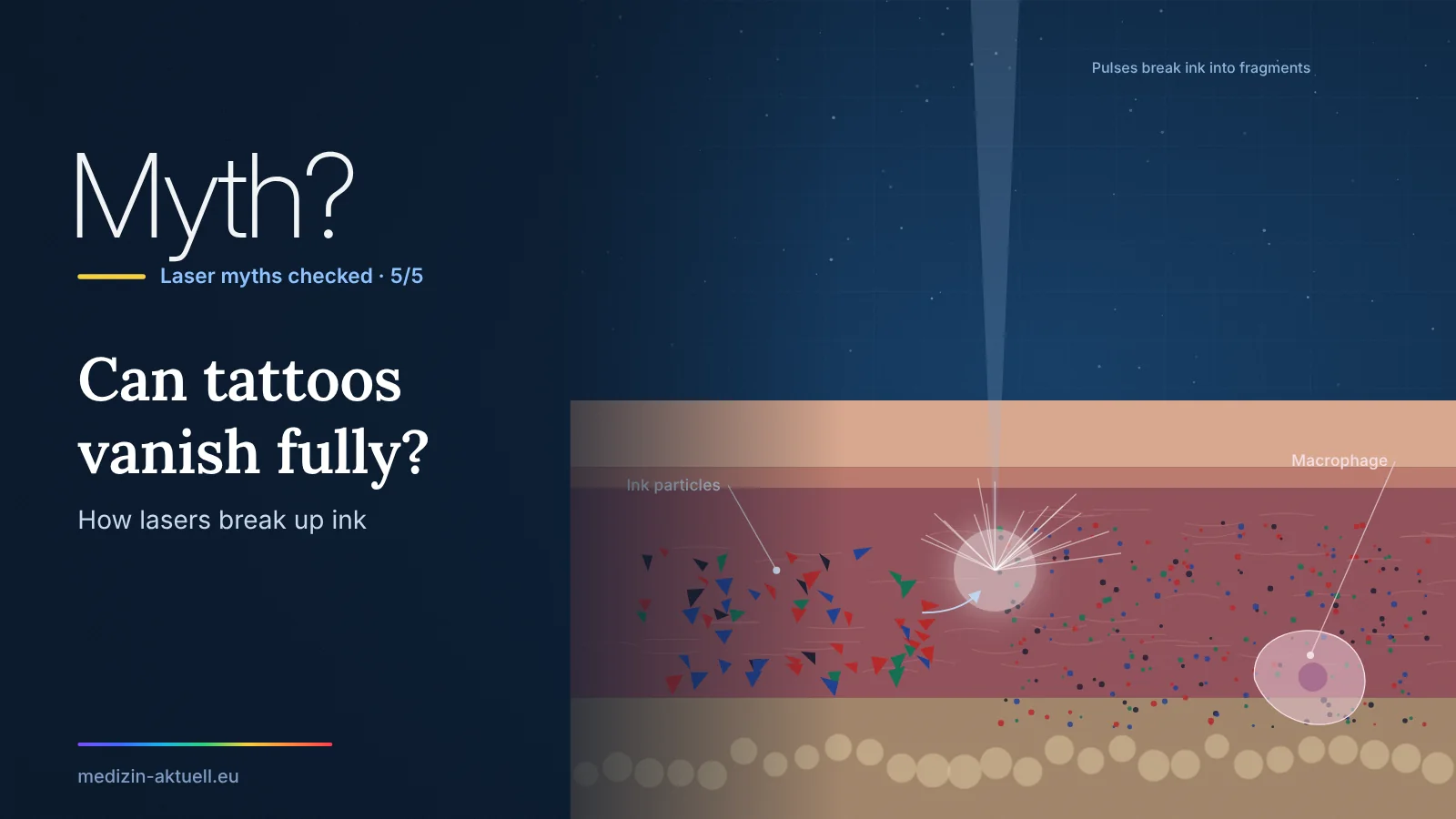
How the laser breaks up tattoo ink
Tattoo ink consists of tiny particles lodged in the dermis. They are too large for the body simply to break them down. Special lasers deliver their energy in extremely short pulses. The particles heat up abruptly and break into smaller fragments. The lymphatic system carries some of them away. According to Germany’s Federal Office for Radiation Protection, ten to fifteen sessions are often needed. IPL devices with broadband flash light are not suitable for tattoo removal.
The German guideline on laser therapy of the skin (AWMF 013-095) describes the usual systems: Q-switched lasers with pulse durations of around 300 picoseconds to 80 nanoseconds. A nanosecond is a billionth of a second; a picosecond is a thousand times shorter. Long pulses must never be used on tattoo pigment, because scarring is then very likely. The principle behind this, selective photothermolysis, is explained in Part 3 of our series on the history of the laser.
Why some tattoos are more stubborn
A widely cited study from 2009 developed the so-called Kirby-Desai scale. The researchers analysed the treatment of 100 patients. On average, about ten sessions were needed – at least three, at most twenty. Six factors influenced the number:
- Skin type: darker skin has to be treated more cautiously.
- Body area: the further a tattoo lies from the trunk, for example on the hands, lower legs or feet, the more sessions are usually needed.
- Colour: black and red were easiest to remove; green, yellow and orange were harder.
- Amount of ink: dense professional tattoos need more sessions than sparse amateur ones.
- Scarring: scarred tissue makes treatment more difficult.
- Layering: a cover-up over an old design contains two layers of ink.
As early as 1990, a study with a Q-switched ruby laser showed that amateur tattoos responded much better than professional ones. Marked lightening or complete removal was achieved in 78 per cent of amateur tattoos but in only 23 per cent of professional tattoos.
Picosecond versus nanosecond
Picosecond lasers were developed because ink particles cool down very quickly. Shorter pulses are therefore meant to shatter them more effectively. In 2016, a systematic review in the journal Lasers in Medical Science found six studies involving 160 people. Depending on the study, 69 to 100 per cent of tattoos achieved more than 70 per cent clearance after one to ten sessions. Mainly black and blue tattoos were studied. According to the authors, however, evidence that picosecond lasers are better than nanosecond lasers is thin.
A larger review published in 2020 in Lasers in Surgery and Medicine sees shorter pulses as an advantage when all other conditions are equal. For you, this means the technology has improved. But even the newest laser offers no guarantee of complete removal.
Risks you should know about
- Scars and pigment changes: light or dark patches and scars are possible, especially with incorrect settings or tanned skin.
- Colour change: a BfS expert points out that light reddish colours can permanently turn black or dark brown.
- Allergies: allergic reactions after tattoo removal with Q-switched lasers were described as early as 1995. It is thought that the broken-up pigment becomes newly visible to the immune system.
- Breakdown products: in 2015, Germany’s Federal Institute for Risk Assessment (BfR) showed in the laboratory that a widely used blue pigment can break down into substances such as hydrogen cyanide and benzene when irradiated with a ruby laser. For very large tattoos, the BfR considers a health risk possible.
- Dirt tattoos: according to the guideline, particles embedded by fireworks, for example, can contain metals or black powder. Under the laser, micro-explosions can then occur.
What this means for you
- Plan for many sessions with breaks in between, so that the skin can heal and the body can carry pigment away. The aim is marked lightening; complete removal is possible but not certain.
- In Germany, laser tattoo removal has been reserved since 31 December 2020 for doctors with the relevant further or continuing training. There is more on the page Laser safety: who may treat?.
- Mention allergies and any reactions to the tattoo beforehand.
- Avoid the sun before and after treatment, as described in Part 3. If a scar remains, the page Laser scar treatment has more information. General preparation tips can be found in the Treatment companion.
Frequently asked questions
Can a tattoo be removed completely?
Sometimes, but not always. Often what remains is lightening with residual pigment or a change in skin texture. A particular result cannot be promised.
How many sessions are needed?
That varies widely. In a study of 100 people the average was about ten, with a range of three to twenty. The BfS often cites ten to fifteen.
Which colours are the most difficult?
Green, yellow and orange are considered more stubborn than black. Light colours can also darken under the laser.
Are picosecond lasers always better?
Shorter pulses are regarded as an advantage, but proof of clear superiority is limited. The right wavelength, correct settings and experience matter more than the type of device.
Series “Laser myths checked”: Back to Part 4: “Home devices work just like clinic lasers” · Part 5: “Tattoos can be lasered off completely” (this article) · Back to the start: Part 1
More laser series: History of the laser · Lasers & AI
Read more: Laser medicine overview · Laser scar treatment · Laser safety: who may treat? · How lasers work
General information, not a substitute for medical advice.
Sources
- Kirby W, Desai A, Desai T, Kartono F, Patel G: The Kirby-Desai Scale: A Proposed Scale to Assess Tattoo-removal Treatments. J Clin Aesthet Dermatol 2(3), 32–37 (2009)
- Reiter O, Atzmony L, Akerman L et al.: Picosecond lasers for tattoo removal: a systematic review. Lasers in Medical Science (2016), PMID 27311768
- ASLMS: Guidelines and recommendations for picosecond lasers in dermatology – on Wu DC et al., Lasers Surg Med (2020)
- Taylor CR et al.: Treatment of tattoos by Q-switched ruby laser. A dose-response study. Archives of Dermatology 126(7) (1990)
- Allergic reactions to tattoo pigment after laser treatment. Dermatologic Surgery (1995), PMID 7728477
- German Federal Institute for Risk Assessment (BfR): Tattoos – auch der Abschied ist nicht ohne Risiko (press release 21/2015, 13 Aug 2015; in German)
- AWMF guideline 013-095: S2k guideline laser therapy of the skin (as of 11 Jan 2022, valid until 10 Jan 2027; in German)
- Asmuß M, Weiskopf D (BfS): Laser, IPL & Co – Applications of optical radiation for cosmetic purposes. UMID 1/2016, pp. 11–17 (in German)
- Asmuß M (Federal Office for Radiation Protection): Anwendung optischer Strahlung am Menschen zu kosmetischen Zwecken (presentation, BfR; in German)
- Federal Office for Radiation Protection (BfS): Professional and home use – NiSV deadlines (doctors-only tattoo removal from 31 Dec 2020)


Leave a Reply