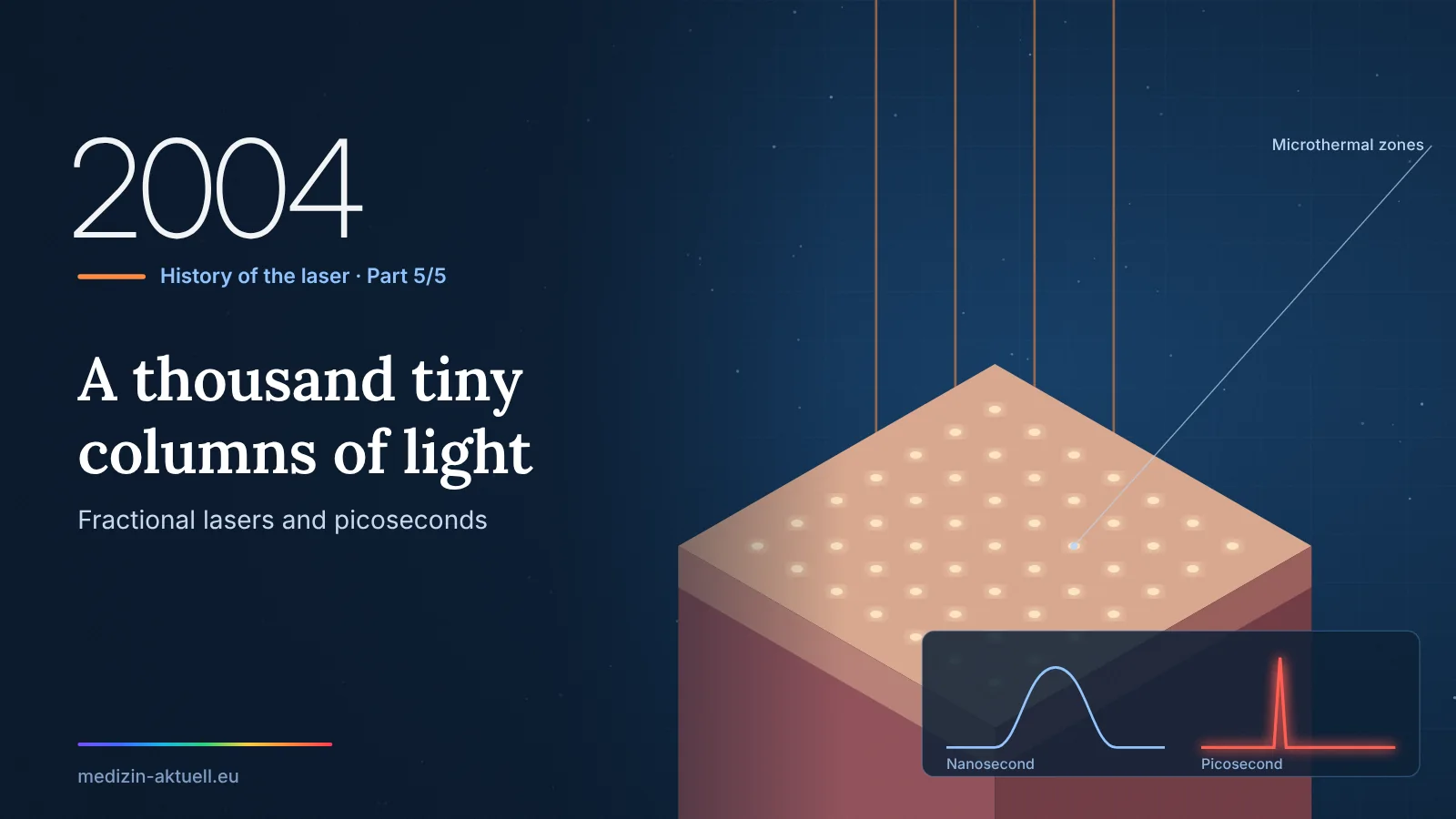
What if you treated not the whole skin but only tiny dots – and the healthy skin in between took care of healing? Researchers led by Dieter Manstein presented this idea in 2004. One of the authors was the same man who had co-founded selective photothermolysis in 1983. In the final part of our series “History of the laser” we look at fractional lasers, picosecond pulses, lasers in urology and the question of where things are heading.
The problem: effect versus downtime
Ablative laser resurfacing emerged in the 1990s. CO2 and erbium YAG lasers removed the upper layers of skin across a whole area, for example in sun-damaged skin; in 1996 specialists reported on pulsed CO2 resurfacing of the face. The effect could be marked. The downside: afterwards the skin was an open wound, healing took time, and redness, infections or pigment changes were possible consequences. Non-ablative procedures spared the surface but were less effective. A middle way was needed.
2004: Fractional photothermolysis
In June 2004 the journal Lasers in Surgery and Medicine published a paper entitled “Fractional photothermolysis: a new concept for cutaneous remodeling using microscopic patterns of thermal injury”. The first author was Dieter Manstein, the senior author R. Rox Anderson.
The idea: a laser creates many microscopically fine columns of heat in the skin, so-called microscopic treatment zones. Untreated skin remains in between. From these healthy islands the skin can heal very quickly. In the study, the treatment zones typically had a diameter of about 100 micrometres – roughly as thin as a hair – and reached around 300 micrometres deep. The two prototypes worked at a wavelength of 1.5 micrometres in the infrared. Among other things, the forearms of 15 volunteers were examined.
Did you know? The original paper states that the outer layer of the skin had closed again within one day. And R. Rox Anderson, co-author of the 2004 paper, had described selective photothermolysis with John Parrish in 1983. Two of the most important ideas in laser dermatology thus bear the same signature.
In the early 2000s the FDA in the USA cleared the first device based on this principle. Fractional versions of ablative lasers such as CO2 and erbium YAG followed later. Today fractional lasers are used above all for scars and sun-related skin changes. How they work is explained on our pages How lasers work and Laser scar treatment.
Picosecond: even shorter
For tattoos, the Q-switched laser with nanosecond pulses was the standard for a long time (see Part 3). The next step was even shorter pulses in the picosecond range, that is, trillionths of a second. In 2012 the FDA approved the first picosecond laser, a 755-nanometre alexandrite laser, for tattoos and pigmented lesions.
With such short pulses, a mechanical effect plays a major role alongside heat: the ink particles are broken up, and the body can carry away the fragments. Here too: how well a tattoo responds to treatment depends on factors such as colour, depth and skin type; a particular result cannot be promised.
Urology: holmium and thulium
Lasers have changed more than skin and eyes. In urology two lasers in particular play a role: the holmium YAG laser at around 2,100 nanometres and the thulium laser at around 2,000 nanometres. Both are strongly absorbed by water and therefore act very superficially. They can be used to break up urinary stones and to remove prostate tissue.
In 1998 urologists led by Peter Gilling and Mark Fraundorfer described holmium laser enucleation of the prostate (HoLEP) in the Journal of Endourology. In this procedure the enlarged inner prostate tissue is detached from the capsule with the laser, pushed into the bladder and broken up and removed there.
Did you know? The European guideline on the treatment of lower urinary tract symptoms in men (EAU, 2026 edition, as of November 2026) gives HoLEP a strong recommendation as an alternative to the classic tissue removal through the urethra (TURP) or to open surgery in men with moderate to severe symptoms. On thulium laser enucleation (ThuLEP) it states that it appears to offer similar efficacy and safety to TURP. Which procedure is right in an individual case is decided by the urologist together with the patient. More on the page Laser urology.
In other specialties, too, lasers are now an established part of treatment, for example for varicose veins (Varicose vein laser) and in dentistry (Laser dentistry).
Looking back: over 100 years in one timeline
- 1917: Einstein describes stimulated emission.
- 1954: The first maser is presented.
- 1960: Theodore Maiman builds the first laser from ruby.
- 1961: First laser treatment of a human retina.
- 1963/64: Leon Goldman reports on lasers and the skin; argon, CO2 and Nd:YAG lasers emerge.
- 1983: Selective photothermolysis; excimer laser on the cornea.
- 1988–1990: First PRK on a living eye, first LASIK.
- 1998: HoLEP is described.
- 2004: Fractional photothermolysis.
- 2011/2012: SMILE study from Germany; first picosecond laser approved in the USA.
Outlook: lasers and artificial intelligence
Where is development heading? One topic that comes up more and more often in research and industry is the combination of laser technology with imaging and artificial intelligence: systems that recognise tissue, suggest settings or document treatments. What has already been tested and what is still a vision for the future can only be answered by looking closely at the evidence. That is exactly the subject of our next series, “Lasers & AI” (coming soon).
Above all, the history of the laser shows one thing: the “solution looking for a problem” became a tool whose value depends on wavelength, pulse duration and energy matching the target – and on being operated by someone with expertise. If you are considering laser treatment, our laser medicine overview and the page Laser safety: who may treat? offer guidance.
Frequently asked questions
What does fractional mean?
The laser treats not the whole area but many tiny dots or columns. The untreated skin in between helps the skin heal faster.
What is the difference between nanosecond and picosecond lasers?
The pulse duration. A nanosecond is a billionth of a second, a picosecond a trillionth. Picosecond pulses break up ink particles more mechanically, while nanosecond pulses act more through heat.
What is HoLEP?
Holmium laser enucleation of the prostate. Enlarged prostate tissue is shelled out from the inside with a holmium laser. The European guideline (EAU, 2026 edition) recommends the procedure as an alternative to TURP or open surgery.
Series “History of the laser”: Back to Part 4: Laser eye surgery – from a turkey to SMILE · Part 5: Fractional lasers and the present day (this article) · Next series: “Lasers & AI”, part 1. Back to the start: Part 1: From Einstein to the first laser
Read more: Laser medicine overview · Laser scar treatment · Laser urology · Treatment companion
General information, not a substitute for medical advice.
Sources
- Manstein D, Herron GS, Sink RK, Tanner H, Anderson RR: Fractional photothermolysis: a new concept for cutaneous remodeling using microscopic patterns of thermal injury. Lasers in Surgery and Medicine 34(5), 426–438 (2004), PMID 15216537
- Graudenz K, Raulin C: Von Einsteins Quantentheorie zur modernen Lasertherapie. Der Hautarzt 54, 575–582 (2003, in German)
- MDedge: Experts reflect on the past 50 years of lasers in dermatology (2020)
- Jakus J, Kailas A: Picosecond Lasers – A New and Emerging Therapy for Skin of Color, Minocycline-induced Pigmentation, and Tattoo Removal. Journal of Clinical and Aesthetic Dermatology 10(3), 14–15 (2017)
- Gilling PJ et al.: Holmium laser enucleation of the prostate (HoLEP) combined with transurethral tissue morcellation. Journal of Endourology 12, 457 (1998)
- European Association of Urology: Guidelines on Management of Non-neurogenic Male LUTS, 2026 edition (accessed November 2026)
- EAU Guidelines 2026, Disease Management chapter (recommendations on HoLEP and thulium laser)


Leave a Reply