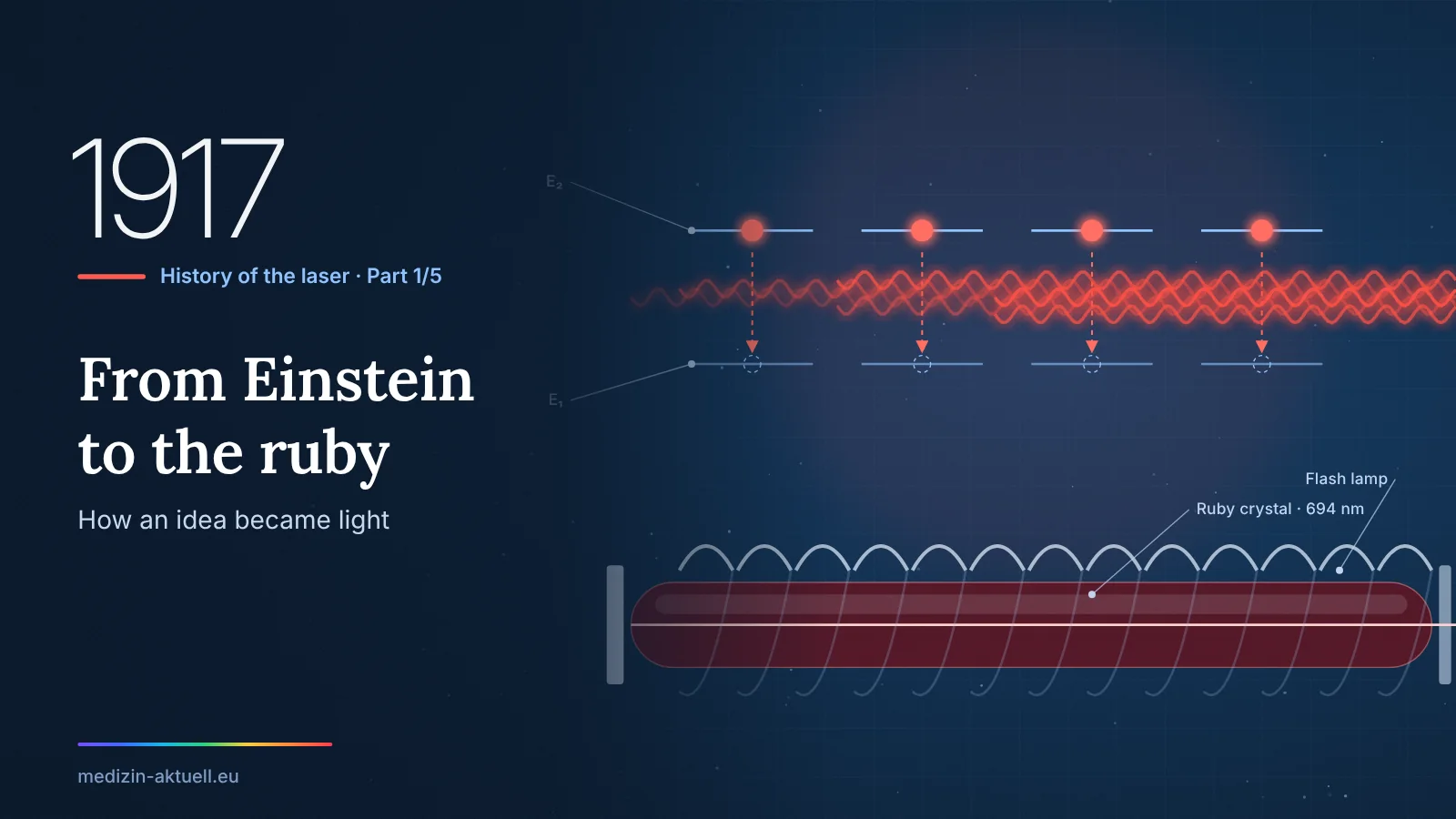
When the first laser flashed into life in May 1960, nobody was quite sure what it was for. One member of the team jokingly called the invention “a solution looking for a problem”. Today laser light is used in eye clinics, dermatology practices and operating theatres. The road there began with a calculation by Albert Einstein, passed through a lunch in a New York cafeteria and ended in a patent dispute lasting decades. Part 1 of our series “History of the laser”.
1917: Einstein’s thought experiment
The history of the laser does not begin in a laboratory but on paper. In 1917 Albert Einstein published a paper on the quantum theory of radiation (“Zur Quantentheorie der Strahlung”). In it he described how atoms and light exchange energy. An atom can take in light (absorption) and give it off again by itself (spontaneous emission). Einstein recognised a third possibility: if a particle of light meets an atom that is already excited, it can prompt that atom to emit a second, identical particle of light. This is called stimulated emission.
One particle of light becomes two, two become four. They share the same wavelength and the same direction, and they oscillate in step. These are exactly the properties that define laser light. Einstein himself, however, was not thinking of a machine. For him, stimulated emission was a building block for explaining the laws of radiation without contradiction. For almost four decades it remained a footnote in physics.
Did you know? The word LASER is an acronym: Light Amplification by Stimulated Emission of Radiation. Einstein’s idea is built into the name.
1954: The maser – microwaves instead of light
The first practical step was taken by researchers working with microwaves. At Columbia University in New York, the physicist Charles Townes, together with James Gordon and Herbert Zeiger, built a device in which excited ammonia molecules amplified microwaves. The group described it in 1954 in the journal Physical Review.
Did you know? According to James Gordon, the team came up with the name in April 1954 over lunch in a university cafeteria: MASER, for Microwave Amplification by Stimulated Emission of Radiation. Later, the M for microwave became the L for light.
Independently, Nikolay Basov and Aleksandr Prokhorov at the Lebedev Institute in Moscow were working on the same principle. In the middle of the Cold War, the foundations of laser technology were thus being laid in East and West at the same time.
1957 and 1958: The race for light
The next question was obvious: could the principle be applied to visible light? Charles Townes and Arthur Schawlow, who worked at Bell Laboratories, did the calculations. In December 1958 their paper “Infrared and Optical Masers” appeared in Physical Review. Among other things, it described how two mirrors at the ends of a medium can bounce light back and forth, amplifying it further and further. In 1960 they were granted a patent for it.
Did you know? Schawlow was married to Townes’s younger sister Aurelia – so two brothers-in-law wrote one of the most important papers in laser physics. Schawlow also had a sense of humour: together with the German physicist Theodor Hänsch he later tried out different flavours of jelly in search of an edible laser.
At almost the same time, a graduate student at Columbia University had similar ideas: Gordon Gould. In November 1957 he wrote down his thoughts in a notebook and had the pages notarised. Gould is regarded as the person who coined the word “laser”. His own patent application of 1959 was initially rejected because Townes and Schawlow had already filed theirs.
Did you know? The dispute over the rights lasted almost thirty years. In 1973 a US appeals court ruled that the Schawlow–Townes patent was too broadly worded. Gould received the first of four laser patents in 1977 and the last in 1988. Only in the late 1980s did he finally prevail against an industry that had long refused to pay him royalties.
16 May 1960: A ruby lights up
Theodore Maiman, a physicist at Hughes Research Laboratories in Malibu, California, chose his own route. He took a synthetic ruby, a small rod about one by two centimetres with mirrored ends. Around it he wound a spiral-shaped xenon flash lamp. His employer was not particularly keen on the project; Maiman was given a budget of 50,000 dollars for nine months.
On 16 May 1960 Maiman and his colleagues Irnee D’Haenens and Charles Asawa fired the lamp. At low energy the ruby merely glowed a faint red. Above a certain threshold, however, it emitted sharp, intense pulses of light at 694.3 nanometres: the world’s first laser was working. On 7 July 1960 Hughes presented the invention to the public; Maiman’s short scientific paper appeared in Nature the same year.
Did you know? The famous press photo of the “first laser” does not show the original at all. Maiman’s ruby and flash lamp were too small for the photographer, so a larger version was photographed instead.
“A solution looking for a problem”
Shortly after the invention, a saying did the rounds: the laser was “a solution looking for a problem”. Who said it first is not entirely clear. An obituary in the trade journal Laser Focus World attributes it to Maiman’s colleague Irnee D’Haenens, whereas the American Physical Society (APS) attributes it to Maiman himself. Either way, the meaning was the same: the device existed, but the applications were still missing.
That changed quickly. As early as 1961, eye doctors in New York aimed a ruby laser at a human retina, and a dermatologist in Cincinnati began studying the effect of laser light on skin. That is the subject of Part 2 of this series.
1964: The Nobel Prize – and who missed out
In 1964 the Royal Swedish Academy of Sciences awarded the Nobel Prize in Physics “for fundamental work in the field of quantum electronics”, which led to the construction of oscillators and amplifiers based on the maser-laser principle. One half went to Charles Townes; Nikolay Basov and Aleksandr Prokhorov shared the other half.
Theodore Maiman, who built the first working laser, was nominated for the Nobel Prize twice according to the APS, but never received it. Arthur Schawlow was honoured in 1981, though for his contributions to laser spectroscopy. Gordon Gould never received a Nobel Prize, but in the end he got his patents.
What this means for medicine
All medical lasers still rely on the principle of 1917: a medium is excited with energy, stimulated emission amplifies the light, and mirrors concentrate it into a beam. What has changed since then are the media, the wavelengths and the duration of the light pulses. How these factors act in tissue is explained on our page How do lasers work in medicine?. An overview of all areas of use can be found in our laser medicine overview.
Frequently asked questions
Who invented the laser?
No single person can be named. Einstein provided the theory in 1917, Townes, Basov and Prokhorov built masers, Schawlow and Townes described the optical laser in 1958, and Gould coined the word. The first working laser was built by Theodore Maiman in 1960.
What is the difference between a maser and a laser?
Both rely on stimulated emission. A maser amplifies microwaves; a laser amplifies light in the ultraviolet, visible or infrared range.
Why was the first laser made of ruby?
Synthetic ruby contains chromium atoms that can be excited well by the light of a flash lamp. Ruby lasers were later also used in medicine.
Series “History of the laser”: Part 1: From Einstein to the first laser (this article) · Continue to Part 2: The first lasers in medicine
Read more: Laser medicine overview · How lasers work · Laser safety: who may treat?
General information, not a substitute for medical advice.
Sources
- Nobelprize.org: The Nobel Prize in Physics 1964
- Gordon JP, Zeiger HJ, Townes CH: Molecular Microwave Oscillator and New Hyperfine Structure in the Microwave Spectrum of NH3. Physical Review 95, 282 (1954)
- Gordon JP: Reflections on the First Maser. Optics & Photonics News, May 2010
- APS News: December 1958 – Invention of the Laser (Schawlow and Townes)
- Optics & Photonics News: Credible (and Edible) Lasers – The Life of Arthur L. Schawlow (2011)
- APS News: May 16, 1960 – Theodore Maiman and the First Laser
- HRL Laboratories: The First Laser
- Maiman TH: Stimulated Optical Radiation in Ruby. Nature 187, 493–494 (1960)
- Encyclopaedia Britannica: Gordon Gould
- Laser Focus World: Irnee D’Haenens, laser pioneer, dies (2008)
- Graudenz K, Raulin C: Von Einsteins Quantentheorie zur modernen Lasertherapie. Der Hautarzt 54, 575–582 (2003, in German)


Leave a Reply