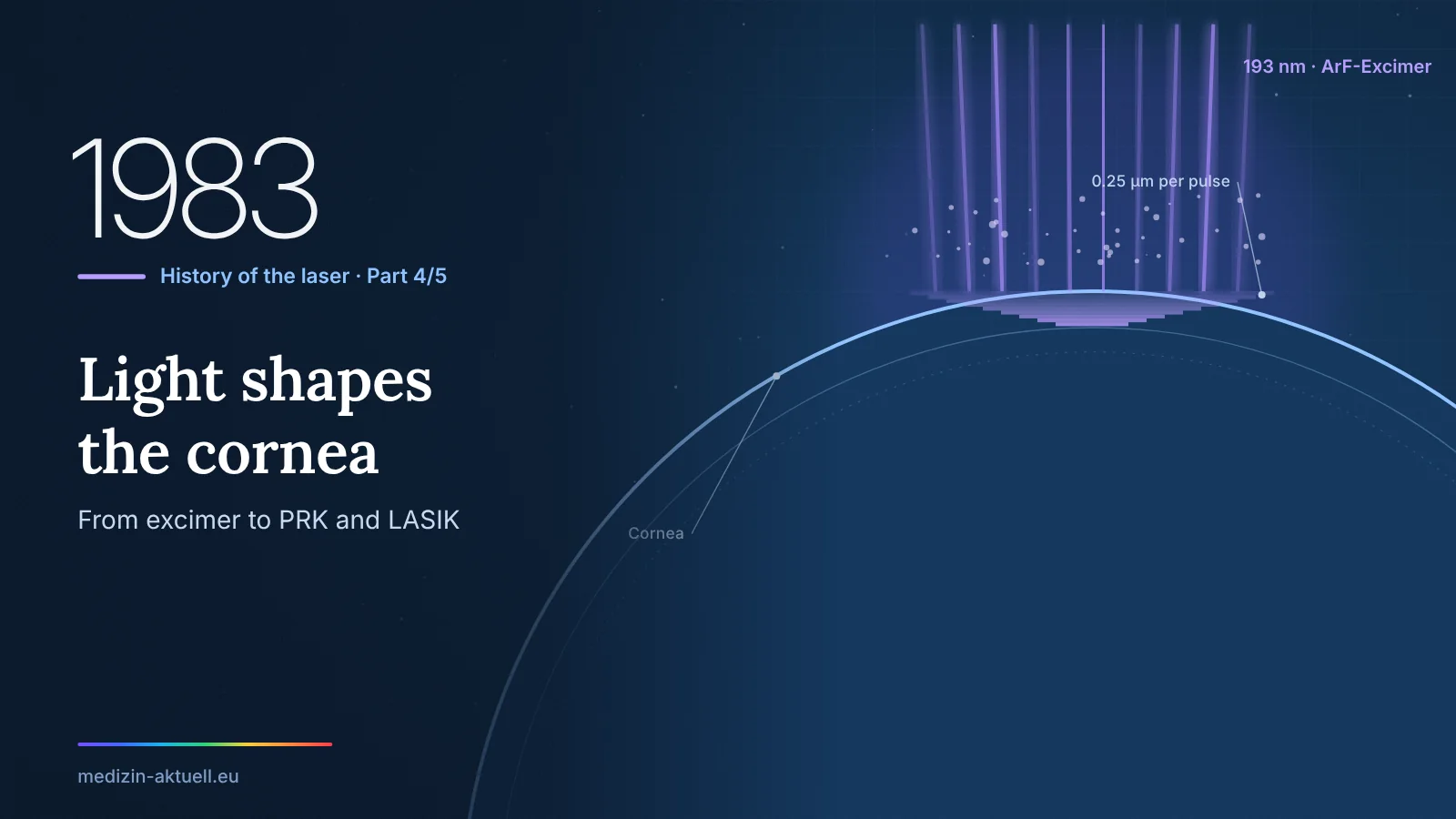
On the day after Thanksgiving 1981 a chemist brought leftovers from the holiday meal into the laboratory: a piece of turkey cartilage. He aimed ultraviolet laser light at it and saw under the microscope a clean, sharp-edged cut – with no charred margins. This experiment at IBM gave rise to one of the most common laser operations in the world: laser eye surgery. Part 4 of our series “History of the laser” follows the road from the turkey via PRK and LASIK to femtosecond lasers and SMILE.
Thanksgiving 1981: A turkey in the lab
At IBM’s Thomas J. Watson Research Center in New York State, Rangaswamy Srinivasan, James Wynne and Samuel Blum were studying what ultraviolet laser light does to organic materials. They were working with an argon fluoride excimer laser, which emits light at a wavelength of 193 nanometres. On 27 November 1981, the day after Thanksgiving, Srinivasan used it to irradiate turkey cartilage. Under the light microscope the result looked like a fine incision.
For comparison, Wynne irradiated a sample with green light from an Nd:YAG laser (532 nanometres). The tissue charred. The difference was decisive: the ultraviolet light breaks apart the molecules at the surface directly instead of heating the tissue. Specialists call this photoablation. Layer by layer, fractions of a micrometre can be removed this way, with almost no heat damage to the surroundings.
Did you know? The three IBM researchers were honoured for their discovery. In 2011 Srinivasan received the National Medal of Technology and Innovation, the highest US award for technological innovation. IBM had filed the patent application in December 1982.
1983: From cartilage to cornea
On 20 May 1983 Srinivasan presented the results publicly at a scientific conference in Baltimore. Shortly afterwards, on 20 July 1983, the New York ophthalmologist Stephen Trokel brought enucleated calf eyes to the IBM laboratory. The corneas were treated with the excimer laser. The joint paper by Trokel, Srinivasan and Bodil Braren appeared in December 1983 in the American Journal of Ophthalmology. It is regarded as the seminal publication of laser surgery for correcting refractive errors.
The idea behind it: the cornea is responsible for a large part of the eye’s refractive power. Flattening or steepening its surface by a few micrometres in a controlled way changes the refractive power and can correct short- or long-sightedness. In November 1983 a first experiment on a living rabbit showed that the cornea had formed no scar after a week.
PRK: The first laser eye treatment in humans
Removing tissue from the corneal surface was named photorefractive keratectomy, or PRK. According to the American Academy of Ophthalmology, the German ophthalmologist Theo Seiler performed the first excimer procedure on a human donor eye in 1987; some other accounts give differing details. According to the same source, in 1988 the US ophthalmologist Marguerite McDonald treated a living human eye with PRK for the first time – that of a short-sighted person. In the USA, excimer laser systems for this treatment were approved by the Food and Drug Administration (FDA) in 1995.
One drawback of PRK: the top cell layer of the cornea, the epithelium, is removed as well. It grows back within a few days, but during this time pain and blurred vision are common.
LASIK: Laser under the flap
The solution came from an older idea. Around 1950 the Spanish ophthalmologist José Barraquer had developed a device that cuts off a thin slice of the cornea, a so-called microkeratome. On 20 June 1989 the ophthalmologist Gholam Peyman received a US patent for a method in which the laser is applied beneath a corneal lamella. In 1990 the Greek ophthalmologist Ioannis Pallikaris performed the first LASIK. He is also regarded as the person who coined the name.
In LASIK a thin corneal flap is first cut and folded aside. The excimer laser reshapes the tissue underneath, and then the flap is laid back. The surface remains largely intact. In the USA, LASIK was formally approved in 1999.
Femtosecond: An accident with consequences
At first the flap was cut with a fine blade. That a laser often does this job today is thanks to an accident. In the early 1990s the graduate student Detao Du was working with ultrashort laser pulses in the laboratory of the physicist Gérard Mourou at the University of Michigan. A laser beam struck him in the eye. The resident doctor Ron Kurtz examined him and found strikingly precise, circular injuries on his retina.
Kurtz recognised the potential: a laser that cuts so precisely could also divide the cornea. In 1994 Kurtz and Du presented their observations and met the physicist Tibor Juhasz. Together they developed the femtosecond laser for eye surgery. A femtosecond is a quadrillionth of a second. According to the American Academy of Ophthalmology, the FDA approved a femtosecond laser for cutting the corneal flap in 2001.
Did you know? The technique that makes such ultrashort yet powerful pulses possible is called chirped pulse amplification. Gérard Mourou and Donna Strickland developed it in the 1980s. In 2018 both received the Nobel Prize in Physics for it, together with Arthur Ashkin, who was honoured for optical tweezers.
SMILE: no flap, through a small incision
The next step did away with the flap altogether. In SMILE (Small Incision Lenticule Extraction), a femtosecond laser cuts a tiny lens of tissue, a so-called lenticule, inside the cornea. It is then pulled out through a small incision a few millimetres long.
Did you know? One of the first larger studies came from Germany. In 2011 ophthalmologists led by Walter Sekundo from Marburg and Erfurt published six-month results for 91 eyes in the British Journal of Ophthalmology. In the USA, approval for short-sightedness followed in September 2016.
Today PRK and related surface procedures, LASIK with a femtosecond laser and SMILE exist side by side. Each procedure has its own requirements and risks, such as dry eyes or sensitivity to glare. Whether laser eye surgery is an option at all can be determined by a thorough examination by an ophthalmologist. An overview of today’s procedures is given on our page Laser eye surgery.
Frequently asked questions
What does a turkey have to do with laser eye surgery?
In 1981 IBM researchers tested the excimer laser on turkey cartilage and saw a clean cut without charring. This gave them the idea of using the method on biological tissue. Corneal surgery developed from it.
What is the difference between PRK, LASIK and SMILE?
In PRK the corneal surface is removed directly. In LASIK a flap is cut first, the laser is applied underneath, and the flap is laid back. In SMILE a femtosecond laser cuts a small lens of tissue inside the cornea, which is removed through a small incision.
What is a femtosecond laser?
A laser with extremely short pulses lasting a few quadrillionths of a second. It can separate tissue very precisely inside the cornea without heating the surroundings much.
Is laser eye surgery suitable for everyone?
No. Corneal thickness, the degree of the refractive error, age and eye health all play a role. Only an examination by an ophthalmologist can clarify whether a procedure is suitable, and which one.
Series “History of the laser”: Back to Part 3: The breakthrough – selective photothermolysis · Part 4: Laser eye surgery – from a turkey to SMILE (this article) · Continue to Part 5: Fractional lasers and the present day
Read more: Laser medicine overview · Laser eye surgery · How lasers work · Treatment companion
General information, not a substitute for medical advice.
Sources
- Healio: Discovery of excimer laser surgery laid foundation for PRK, LASIK (2022)
- Photonics.com: Give Thanks to the Turkey for Lasik (2013)
- National Science and Technology Medals Foundation: Rangaswamy Srinivasan
- Trokel SL, Srinivasan R, Braren B: Excimer Laser Surgery of the Cornea. American Journal of Ophthalmology 96(6), 710–715 (1983)
- American Academy of Ophthalmology, EyeNet: A Look at LASIK – Past, Present and Future (2009)
- Palanker DV, Blumenkranz MS, Marmor MF: Fifty Years of Ophthalmic Laser Therapy. Archives of Ophthalmology 129(12), 1613–1619 (2011)
- Golden Goose Award: Tibor Juhasz, Ron Kurtz, Detao Du, Gérard Mourou and Donna Strickland
- IEEE Spectrum: 2018 Nobel Physics Prize for Laser Work
- Sekundo W, Kunert KS, Blum M: Small incision corneal refractive surgery using the small incision lenticule extraction (SMILE) procedure. British Journal of Ophthalmology 95(3), 335–339 (2011)
- Review of Ophthalmology: FDA approval of the SMILE procedure (October 2016)


Leave a Reply