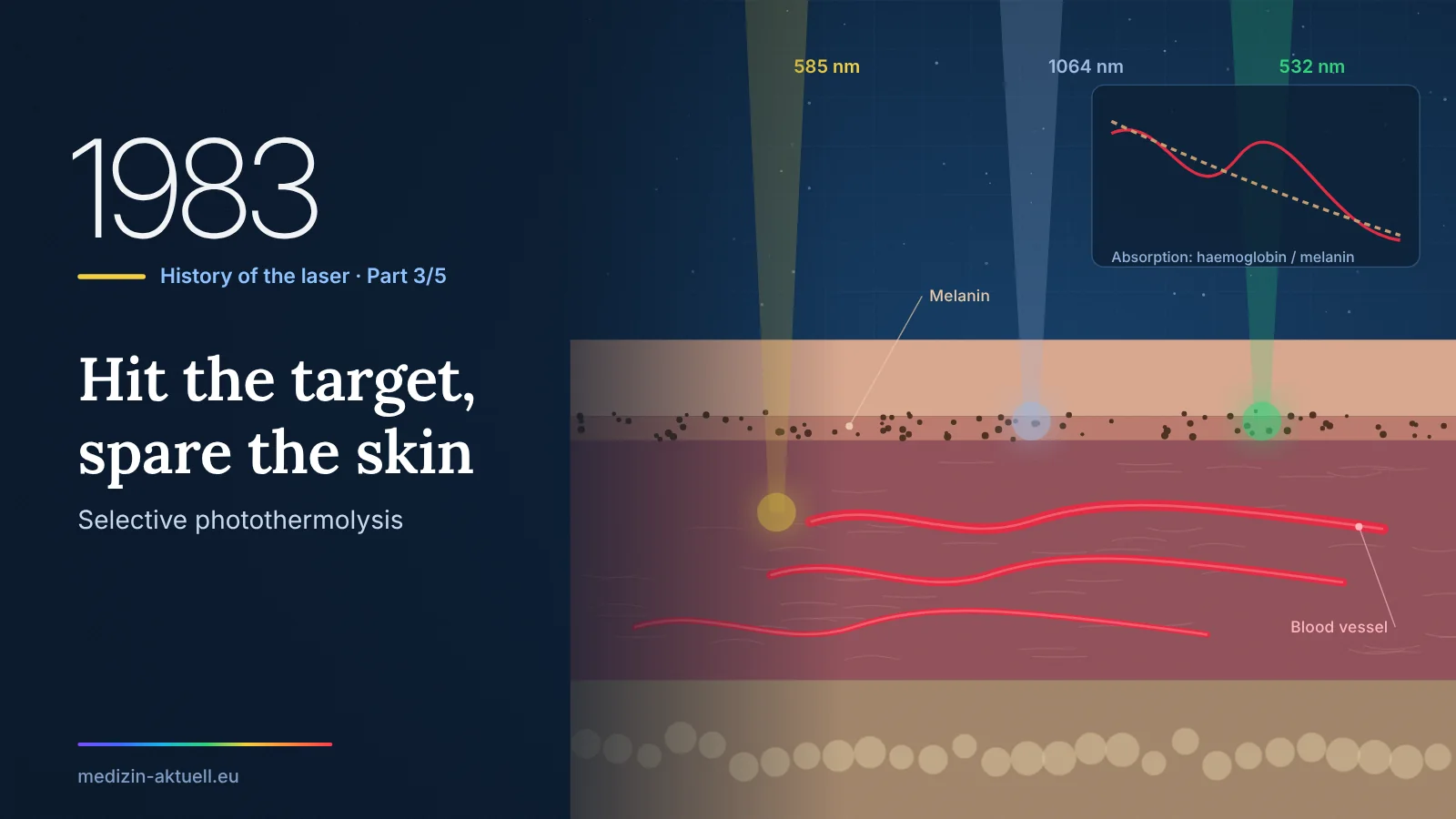
A pulse of light shorter than a millionth of a second strikes a tiny blood vessel in the skin. The vessel is destroyed, while the skin around it is largely spared. What sounds obvious today was a small revolution in the early 1980s. In 1983 two researchers from Boston summed it up in an unwieldy term: selective photothermolysis. Without this principle, most of today’s laser treatments of the skin would not exist. Part 3 of our series “History of the laser”.
The problem with the early lasers
By the 1970s lasers had arrived in dermatology, above all the argon and CO2 lasers. Both, however, delivered their energy as a continuous beam or in comparatively long pulses. The heat did not stay where it was meant to act. It flowed into the surrounding tissue. With port-wine stains, which are congenital vascular malformations of the skin, this could leave scars. Treatment was therefore often a compromise between effect and side effects.
1983: A principle with an unwieldy name
In late April 1983 the journal Science published a paper by R. Rox Anderson and John A. Parrish of Massachusetts General Hospital in Boston. Its title: “Selective photothermolysis: precise microsurgery by selective absorption of pulsed radiation”. As early as 1981 the two had shown that dye lasers can selectively damage the smallest blood vessels. Now they supplied the general rule and a simple predictive model to go with it.
The term can be broken down into its parts: selective means targeted, photo stands for light, thermo for heat and lysis for breakdown. It means targeted destruction by heat generated from light. For this to work, three conditions must be met:
- The right wavelength: the target must absorb the light much more strongly than its surroundings. For blood vessels this is the red blood pigment haemoglobin, for pigmented spots and hair it is melanin, and for tattoos it is the ink particles.
- The right pulse duration: the light pulse must be shorter than the time the target needs to cool down. Specialists call this the thermal relaxation time. Small targets such as pigment granules cool in fractions of a microsecond, larger ones such as blood vessels or hair roots in milliseconds.
- Enough energy: only then is the target heated sufficiently.
Did you know? In their paper Anderson and Parrish described two examples. They damaged small skin vessels with yellow light at 577 nanometres and pulses of about three ten-millionths of a second. They hit pigment granules inside pigment cells with ultraviolet light at 351 nanometres and pulses of about twenty billionths of a second.
The clever part: because selection depends on the physical properties of the target, there is no need to aim at each vessel individually. The beam can sweep across an area; even so, it is mainly whatever absorbs the light strongly that heats up.
Blood vessels: the pulsed dye laser
The first major application was blood vessels. The pulsed dye laser was built on the new principle – a laser whose medium is a liquid dye and which emits yellow light in the range absorbed by haemoglobin. In February 1989 Oon Tian Tan and colleagues reported in the New England Journal of Medicine on the treatment of 35 children with port-wine stains, aged from three months to 14 years. The paper is regarded as a milestone in the laser treatment of port-wine stains in childhood.
Today pulsed dye lasers are among the standard devices for port-wine stains, dilated small vessels and redness. Which vascular lasers exist and what they are used for is explained on our page Vascular laser.
Pigment and tattoos: the Q-switched laser
Pigment and tattoo ink require even shorter pulses, because the ink particles are tiny and cool down very quickly. Q-switched lasers are suited to this. They store energy and release it in a pulse lasting a few billionths of a second, in the nanosecond range.
In 1990 a group from Massachusetts General Hospital published a dose-response study using a Q-switched ruby laser (694 nanometres, pulses of 40 to 80 nanoseconds) on 57 blue-black tattoos. In 1989 Anderson and colleagues had also studied the Q-switched Nd:YAG laser for skin pigmentation, and in the early 1990s work on the 755-nanometre alexandrite laser followed.
Did you know? In the 1990 study, amateur tattoos responded much better than professional ones: 78 percent of amateur tattoos but only 23 percent of professional tattoos showed substantial lightening or complete clearance. At the same time, the authors frequently observed pale, patchy loss of pigment. An outcome can therefore never be promised.
Hair: back to ruby
Hair roots also contain melanin. According to the principle of selective photothermolysis, it should therefore be possible to damage them selectively. In December 1996 the Journal of the American Academy of Dermatology published a study from Anderson’s group, with Melanie Grossman as first author. 13 volunteers with brown or black hair were treated with a ruby laser in normal mode, that is, with pulses in the millisecond range. After six months, fewer than half of the hairs had regrown in four of them.
Diode lasers at 810 nanometres followed at the end of the 1990s, and other wavelengths later. Because melanin is also present in the outer layer of the skin, skin type still plays an important role in choosing the laser.
Did you know? Ruby closes a circle: in 1960 a ruby crystal glowed in the world’s first laser, and in 1996 the same type of crystal stood at the beginning of modern laser hair removal.
Why the principle still matters today
Selective photothermolysis also explains why laser treatments are not interchangeable. Wavelength, pulse duration, energy and cooling must match the target and the skin type. Wrong settings can cause burns, scars or pigment changes. This is why, in Germany, the radiation protection ordinance NiSV regulates who may carry out which laser applications; more on the page Laser safety: who may treat?. How to prepare for a treatment is shown in the Treatment companion.
Frequently asked questions
What does selective photothermolysis mean?
The targeted destruction of a structure by heat that light generates within it. Wavelength, pulse duration and energy are chosen so that mainly the target is heated and the surrounding tissue is spared as far as possible.
What is the thermal relaxation time?
The time a heated structure needs to give off a large part of its heat to its surroundings. If the light pulse is shorter, the heat stays mainly in the target.
Why are different lasers needed for tattoos and for blood vessels?
Ink particles are much smaller than blood vessels and cool down faster. They therefore need extremely short pulses in the nanosecond or picosecond range and, depending on the colour, a matching wavelength.
Does the principle apply equally to all skin types?
No. Melanin in the outer layer of the skin also absorbs light. With darker or tanned skin, wavelength and settings must be chosen especially carefully to avoid damage.
Series “History of the laser”: Back to Part 2: The first lasers in medicine · Part 3: The breakthrough – selective photothermolysis (this article) · Continue to Part 4: Laser eye surgery – from a turkey to SMILE
Read more: Laser medicine overview · How lasers work · Vascular laser · Laser scar treatment
General information, not a substitute for medical advice.
Sources
- Anderson RR, Parrish JA: Selective photothermolysis: precise microsurgery by selective absorption of pulsed radiation. Science (1983), PMID 6836297
- Graudenz K, Raulin C: Von Einsteins Quantentheorie zur modernen Lasertherapie. Der Hautarzt 54, 575–582 (2003, in German)
- Tan OT, Sherwood K, Gilchrest BA: Treatment of children with port-wine stains using the flashlamp-pulsed tunable dye laser. New England Journal of Medicine (1989), PMID 2913507
- Taylor CR et al.: Treatment of tattoos by Q-switched ruby laser. A dose-response study. Archives of Dermatology 126(7) (1990)
- Grossman MC et al.: Damage to hair follicles by normal-mode ruby laser pulses. Journal of the American Academy of Dermatology (1996), PMID 8959946
- MDedge: Experts reflect on the past 50 years of lasers in dermatology (2020)


Leave a Reply