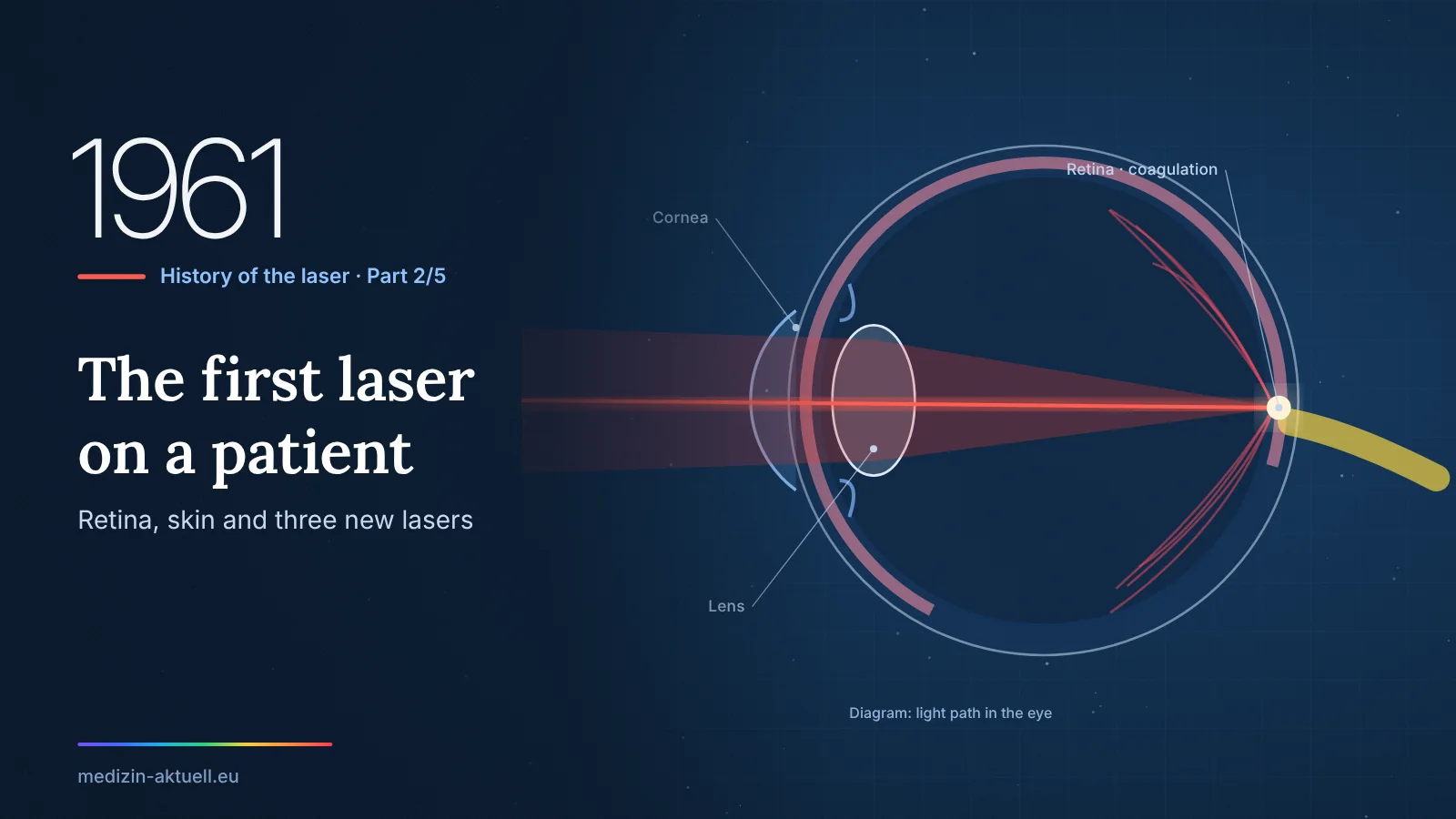
Barely a year and a half after the first laser, a patient in New York lay beneath a ruby beam. A single flash of light, lasting about a thousandth of a second, was meant to destroy a tumour in his retina. At the same time, a dermatologist in Cincinnati was aiming laser light at the skin of volunteers. The 1960s were the decade in which the “solution looking for a problem” found its first patients. Part 2 of our series “History of the laser”.
Before the laser: sunlight on the retina
The idea of treating the eye with light is older than the laser. In 1949 the German ophthalmologist Gerhard Meyer-Schwickerath focused sunlight onto patients’ retinas to treat tumours. It was the first deliberate use of light burns for healing. In the mid-1950s devices with xenon arc lamps came onto the market. They worked, but they were hard to control.
Why the eye of all places? The cornea, lens and vitreous body are transparent. Light reaches the retina without any need to cut. There it is absorbed by pigment and by the blood’s red pigment and converted into heat. The heat welds (coagulates) the tissue. A laser, with its tightly focused beam, promised to do exactly that far more precisely.
1961: The first laser procedure on a human
In 1961 Milton Zaret and colleagues published a paper in the journal Science describing changes that a ruby laser produced in the iris and retina of rabbits. It is regarded as the first laser study of eye tissue.
A few months later, a human patient was treated. On 22 November 1961 the ophthalmologist Charles J. Campbell at the Edward S. Harkness Eye Institute of Columbia-Presbyterian Medical Center in New York treated a patient with a vascular tumour (angioma) of the retina. The ruby laser had been supplied by the company American Optical; its representative Charles Koester was present. A single pulse lasting about a thousandth of a second destroyed the tumour.
Did you know? The laser was also more comfortable for patients. According to the hospital, the older xenon devices worked with 1,000-watt lamps – the laser flash, by contrast, was over in a fraction of a second.
Leon Goldman: a dermatologist discovers the laser
Meanwhile, in Cincinnati, a dermatologist became interested in the new light source: Leon Goldman (1905–1997). He had worked at the University of Cincinnati since 1929 and chaired a department there for more than 35 years. Shortly after the laser was invented he began experimenting. In 1963 his preliminary report on the effect of the laser beam on the skin appeared in the Journal of Investigative Dermatology.
In the following years his group studied laser light on moles and melanomas (1964), on tattoos (1965) and on port-wine stains (1968). In 1967 Goldman reported in the journal JAMA on three years of experience with laser treatment of tattoos. This made him one of the first to go beyond marvelling at lasers and to document their effects in humans systematically.
Goldman is often called the “father of laser medicine”; the Dermatology Hall of Fame calls him the “father of laser surgery”. He was the founding president of the American Society for Laser Medicine and Surgery, a professional society that still exists today.
Did you know? A motto is said to have hung in Goldman’s laboratory that is as relevant today as it was then: “If you don’t need the laser, don’t use it.”
Three new lasers: argon, CO2 and Nd:YAG
The ruby laser had drawbacks. Its red light is only moderately absorbed by the blood’s red pigment, and it delivered only single pulses. In 1963 and 1964 three new types of laser arrived that would shape medicine for decades.
The argon laser: On 14 February 1964 the physicist William Bridges discovered the argon ion laser at Hughes Research Laboratories. Its blue-green light is absorbed well by the blood pigment haemoglobin and by the pigment melanin. For ophthalmology this was ideal. In 1968 the ophthalmologist Francis L’Esperance described an argon device for treating the retina, and in 1969 he reported on a large group of patients. From 1970 argon lasers coupled to a slit lamp were commercially available; by the early 1970s laser treatment of the retina had become widely accepted, for example for retinal damage caused by diabetes. More on this on our page Laser eye surgery.
The CO2 laser: At Bell Laboratories the physicist C. Kumar N. Patel developed the carbon dioxide laser in 1963/64. At 10,600 nanometres its light lies far in the infrared and is strongly absorbed by the water in tissue. The tissue vaporises where the beam strikes. This made the CO2 laser a kind of light scalpel. In 1972 the doctors M. Stuart Strong and Geza Jako reported on their first clinical experience with the CO2 laser in operations on the larynx.
The Nd:YAG laser: Also at Bell Laboratories, Joseph Geusic and colleagues presented the neodymium YAG laser in 1964, a crystal laser emitting at 1,064 nanometres. Its light penetrates deeper into tissue. It later became indispensable in ophthalmology: in 1979 the French ophthalmologist Danièle Aron-Rosa used such a laser to treat so-called after-cataract, a clouding that can occur after cataract surgery.
Did you know? All three lasers – argon, CO2 and Nd:YAG – came from industrial laboratories, not from hospitals. The physicists were looking for new wavelengths; the doctors found the matching problems.
The downside: heat without precision
For all the enthusiasm, the early lasers had a problem. They delivered their energy either as a continuous beam or in relatively long pulses. The heat did not stay in the target but spread into the surrounding tissue. With port-wine stains, for example, which in the 1970s and early 1980s were often treated with argon lasers, scarring could result.
The crucial question was therefore: how do you hit only what you want to hit? The answer came from Boston in 1983 and was called selective photothermolysis. It is the subject of Part 3. How wavelength and pulse duration work together is also explained on our page How lasers work; today’s vascular treatments are described on the page Vascular laser.
Frequently asked questions
When was a laser first used on a human?
The procedure of 22 November 1961 in New York is regarded as the first documented laser treatment: a ruby laser destroyed a vascular tumour in a patient’s retina.
Why was the eye the first organ to be treated with lasers?
Because light passes through the transparent parts of the eye to the retina without the need for an incision. Ophthalmologists were also already treating the retina with focused light before the laser existed.
Who was Leon Goldman?
A dermatologist from Cincinnati who, from the early 1960s, systematically researched the effect of laser light on skin. He was the founding president of the American Society for Laser Medicine and Surgery and is regarded as one of the founders of laser medicine.
Are the lasers of that time still used today?
The laser types are, though of course the devices have been developed much further. CO2 and Nd:YAG lasers remain among the important medical lasers. Which laser is suitable in an individual case is a medical decision.
Series “History of the laser”: Back to Part 1: From Einstein to the first laser · Part 2: The first lasers in medicine (this article) · Continue to Part 3: The breakthrough – selective photothermolysis
Read more: Laser medicine overview · Laser eye surgery · Vascular laser · How lasers work
General information, not a substitute for medical advice.
Sources
- Palanker DV, Blumenkranz MS, Marmor MF: Fifty Years of Ophthalmic Laser Therapy. Archives of Ophthalmology 129(12), 1613–1619 (2011)
- NewYork-Presbyterian Health Matters: It Happened Here – The Ruby Laser
- Columbia University, Department of Ophthalmology: Ruby Laser Prototype
- Goldman L et al.: Effect of the laser beam on the skin. Preliminary report. Journal of Investigative Dermatology (1963), PMID 13948765
- Dermatology Hall of Fame: Leon Goldman, MD
- Graudenz K, Raulin C: Von Einsteins Quantentheorie zur modernen Lasertherapie. Der Hautarzt 54, 575–582 (2003, in German)
- Caltech: Celebrating 50 Years of the Argon Ion Laser
- Optica: Biography of C. Kumar N. Patel
- Strong MS, Jako GJ: Laser Surgery in the Larynx – Early Clinical Experience with Continuous CO2 Laser. Annals of Otology, Rhinology & Laryngology 81(6), 791–798 (1972)
- Optica: Biography of Joseph E. Geusic
- MDedge: Experts reflect on the past 50 years of lasers in dermatology (2020)


Leave a Reply