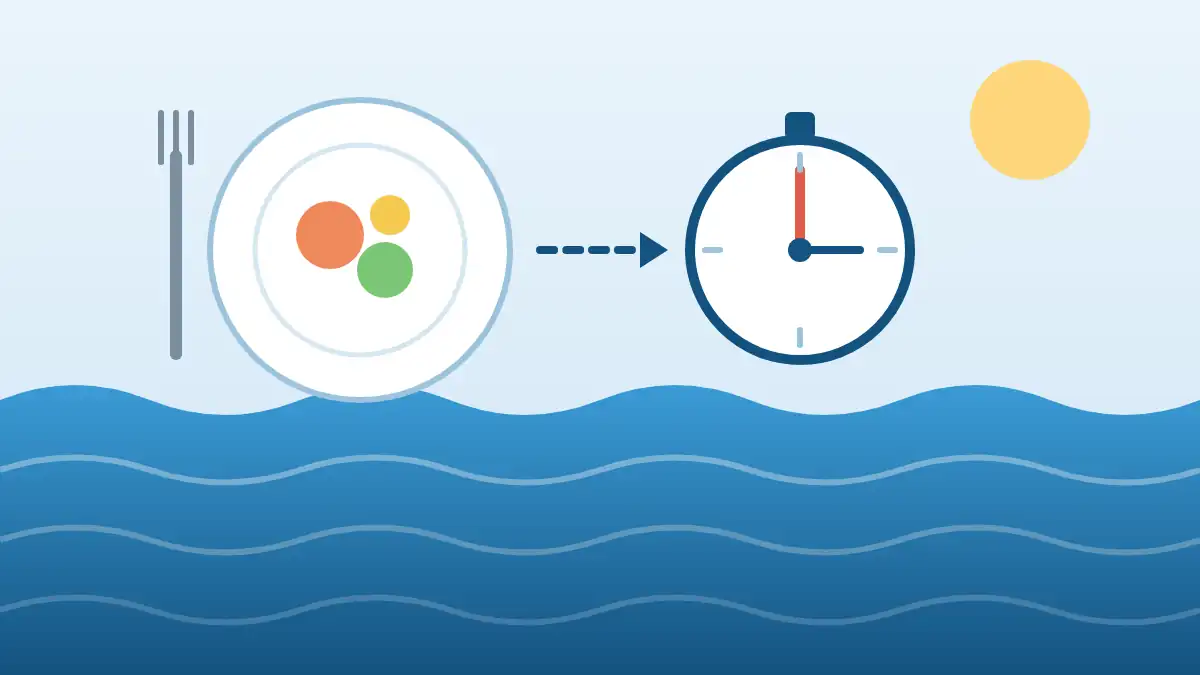
“Wait an hour after eating, or you’ll get cramps and drown!” Many of us heard this as children at the lake or the pool. But is swimming after eating really dangerous?
Short answer: There is no evidence that swimming right after a meal causes cramps or leads to drowning. A scientific review by the American Red Cross did not find a single documented case. After a very large meal, exercise can feel uncomfortable, though – so a short break can make sense for comfort.
Where the myth comes from
The idea is old and sounds plausible at first: digestion needs a lot of blood after a meal. The theory goes that too little is left for the muscles – leading to cramps, and a cramp in the water could make you drown. Even the American Red Cross advised against swimming straight after eating in the 1960s. From there, the “one-hour rule” spread through families, swimming pools and summer camps.
The idea is firmly rooted in Germany, too. The bathing rules of the German Life Saving Association (DLRG) say: never go swimming with a completely full or a completely empty stomach. They do not, however, mention a specific waiting time.
What the research shows
The most thorough look at the question comes from the Scientific Advisory Council of the American Red Cross. For a review published in 2011, the experts searched several large medical databases for studies on eating and swimming. Their finding: in all the literature searched, there was no report of a case in which eating before swimming caused or contributed to a fatal or non-fatal drowning. The authors conclude that eating before swimming is not a risk factor for drowning and can be dismissed as a myth. They consider food restrictions before swimming unnecessary.
The few direct experiments date from the 1960s and are small. In one study of 12 young swimmers, a large meal led to nausea four times and regurgitation once across 192 trials – no stomach cramps were observed. In another study with 14 swimmers and 840 trials, with waiting times between half an hour and three hours, neither nausea nor cramps occurred, and the waiting time made no significant difference. These studies have clear limits: few participants, mostly young, athletic men. More recent research is scarce.
In its current information, the Red Cross states that swimming within one hour of eating does not increase the risk of drowning and that no major medical or safety organisation currently recommends waiting. What can happen is a side stitch: Australian research from 2005 suggests it may be more common when exercising less than two hours after a big meal – but it did not point to a serious health threat.
It is worth looking at the real dangers. According to the World Health Organization (WHO), around 300,000 people drown worldwide every year. Young children are particularly at risk. Among risky behaviours, the WHO mentions drinking alcohol before swimming alone. According to the WHO, the most effective protection is supervision, barriers controlling access to water and swimming lessons for children.
What this means for you
You don’t need to watch the clock after a picnic by the lake. A sandwich, some fruit or an ice cream is no reason to sit on the shore for an hour. After a large, fatty meal, however, many people feel sluggish or bloated in the water. In that case it makes sense to take it easy or wait a little – not out of fear of drowning, but because it is more comfortable. A completely empty stomach isn’t ideal either: the German automobile club ADAC points out that low blood sugar can become dangerous in the water.
Far more important than the timing of your last meal: no alcohol before swimming, don’t overestimate your strength, swim only in supervised or familiar waters, and never take your eyes off children in or near the water. If you feel unwell in the water, head back to shore. You will find more common misconceptions in our myth checks “Does cold weather make you sick?” and “Does sugar make kids hyperactive?”.
Frequently asked questions
How long should you wait to swim after eating?
Based on current knowledge, no fixed waiting time is needed. After a light meal you can go straight into the water. After a very large meal, a short break may feel better, because otherwise bloating or a side stitch can occur.
Can swimming after eating cause cramps?
There is no evidence for this. In studies of swimmers who had eaten beforehand, no stomach cramps were observed. Nausea occurred occasionally.
Can children swim after eating?
Yes. The same applies to children as to adults. What matters is not the meal but supervision: children in and near the water should always be watched by an adult.
Is it better to swim on an empty stomach?
Not necessarily. The DLRG advises against swimming with either a completely full or a completely empty stomach. If you haven’t eaten for a long time, you risk low blood sugar – which can be dangerous in the water.
This article is for general information only and does not replace medical advice.
Sources
- Chambers P, Quan L, Wernicki P, Markenson D: American Red Cross Scientific Advisory Committee Scientific Review: Eating Before Swimming. International Journal of Aquatic Research and Education 2011;5(4):483–492. Full text (PDF)
- American Red Cross: Should You Eat Right Before Swimming? (published 8 July 2024). redcross.org
- World Health Organization (WHO): Drowning – Fact Sheet (1 May 2026). who.int
- DLRG: Baderegeln (bathing rules, Mössingen branch, in German). dlrg.de (PDF)
- ADAC: Faktencheck: Darf man nach dem Essen schwimmen? (8 June 2026, in German). adac.de
- BBC Science Focus: Is it true that you must wait an hour after eating before going for a swim? sciencefocus.com


Leave a Reply