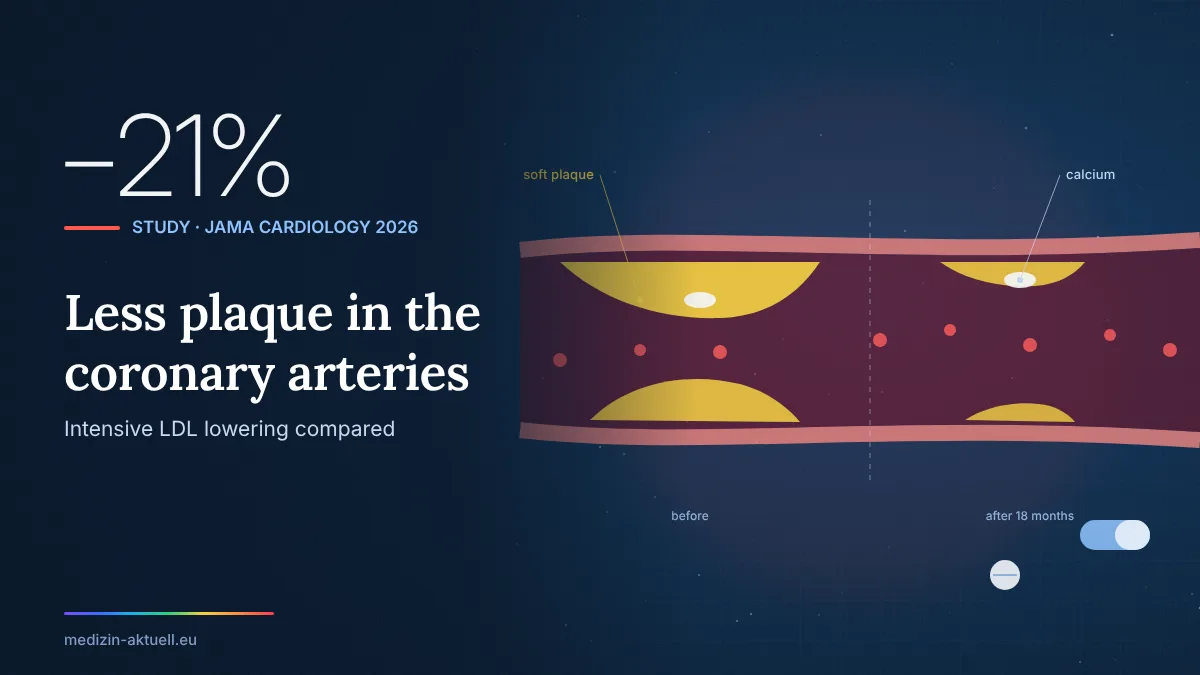
Can plaque in the coronary arteries shrink? A Danish study in JAMA Cardiology (October 2026) shows that in people with newly diagnosed coronary artery disease, the deposits shrank more under particularly intensive cholesterol lowering with two drugs than under a standard statin.
In short: In the FLOWPROMOTE trial of 104 patients, plaque volume fell by about 21 per cent over 18 months with rosuvastatin plus ezetimibe and by about 14 per cent with atorvastatin alone. The lower the LDL cholesterol, the greater the regression. Whether this also prevents heart attacks was not studied.
What is it about?
In coronary artery disease, fats, inflammatory cells and later calcium build up in the walls of the coronary arteries – the so-called plaque. It can narrow the vessels and, if it ruptures, trigger a heart attack. Soft, non-calcified plaque is considered particularly dangerous. The main driver of these deposits is LDL cholesterol. Statins lower it, and guidelines recommend very low targets for people at high risk. Ezetimibe complements statins by reducing the absorption of cholesterol from the gut. More in our encyclopedia: Statins and Atherosclerosis.
The study
The FLOWPROMOTE trial was carried out at three Danish hospitals: Aarhus University Hospital, Sygehus Lillebælt and Sydvestjysk Sygehus. It included 104 people with newly diagnosed stable coronary artery disease who had not previously taken statins. They were randomly assigned to one of two treatments:
- Combination: rosuvastatin 40 mg plus ezetimibe 10 mg daily
- Standard: atorvastatin 40 mg daily
The coronary arteries were examined by CT angiography at the start, after 9 months and after 18 months. The images were analysed blind, without knowing who received which treatment. The published data are prespecified secondary analyses of the trial.
The results
- LDL cholesterol: According to the researchers, it fell by about 65 per cent with the combination and by about 38 per cent with atorvastatin.
- Total plaque: Volume decreased by about 21 per cent and 14 per cent, respectively.
- Soft (non-calcified) plaque: minus 28 per cent versus minus 20 per cent.
- How many benefited? Plaque regressed in about 90 per cent of the combination group and about 75 per cent of the standard group.
- Calcified plaque: It increased slightly in both groups. This is a known effect of statin treatment and is interpreted as stabilisation.
Across all participants, the lower the LDL cholesterol achieved, the greater the regression.
Putting it into context
The study supports the principle of “the lower, the better” for LDL cholesterol – and shows that plaque in the coronary arteries can indeed regress under good treatment. But there are limits: the trial was small, and it measured plaque volume as a surrogate marker, not the number of heart attacks or deaths. Because the groups differed both in the statin and in the added ezetimibe, it is not possible to say how much each drug contributed. Four in five participants were men. The hospital’s announcement did not include data on side effects. The study was funded by the Novo Nordisk Fonden, a Danish foundation.
What does this mean for patients?
For people with coronary artery disease, the study confirms how important consistent LDL cholesterol lowering is. Statins and ezetimibe have been approved for many years and are well studied. Which medicines and which targets make sense depends on your individual risk and should be decided with your doctor. Please do not stop or switch medicines on your own – muscle complaints on statins should also be discussed with a doctor. What your blood lipid values mean is explained in our encyclopedia under Cholesterol.
Frequently asked questions
Can coronary plaque be reversed?
Partly, yes. Imaging studies show that soft, non-calcified plaque in particular can shrink when LDL cholesterol is lowered intensively. Calcified parts usually remain.
What is ezetimibe?
Ezetimibe is a cholesterol-lowering drug that reduces the absorption of cholesterol from the gut. It is often combined with a statin when LDL cholesterol needs to be lowered further.
How low should LDL cholesterol be?
That depends on your individual cardiovascular risk. For people with known coronary artery disease, European guidelines recommend very low targets. The right target is set by your doctor.
Does less plaque prevent heart attacks?
This study did not examine that. However, large trials show that stronger LDL lowering reduces the risk of heart attacks and strokes.
Note: This article is for general information only and does not replace medical advice.
Sources
- Aarhus University Hospital: press release on the FLOWPROMOTE results (in Danish, 2 November 2026) – original paper: Mortensen MB et al., JAMA Cardiology, 30 October 2026, DOI 10.1001/jamacardio.2026.4788
- Summary of the FLOWPROMOTE results (design, doses, plaque volume)
- Stronger cholesterol treatment shrinks more plaque in heart arteries (November 2026)
- Trial registry NCT04737408 (FLOWPROMOTE)


Leave a Reply