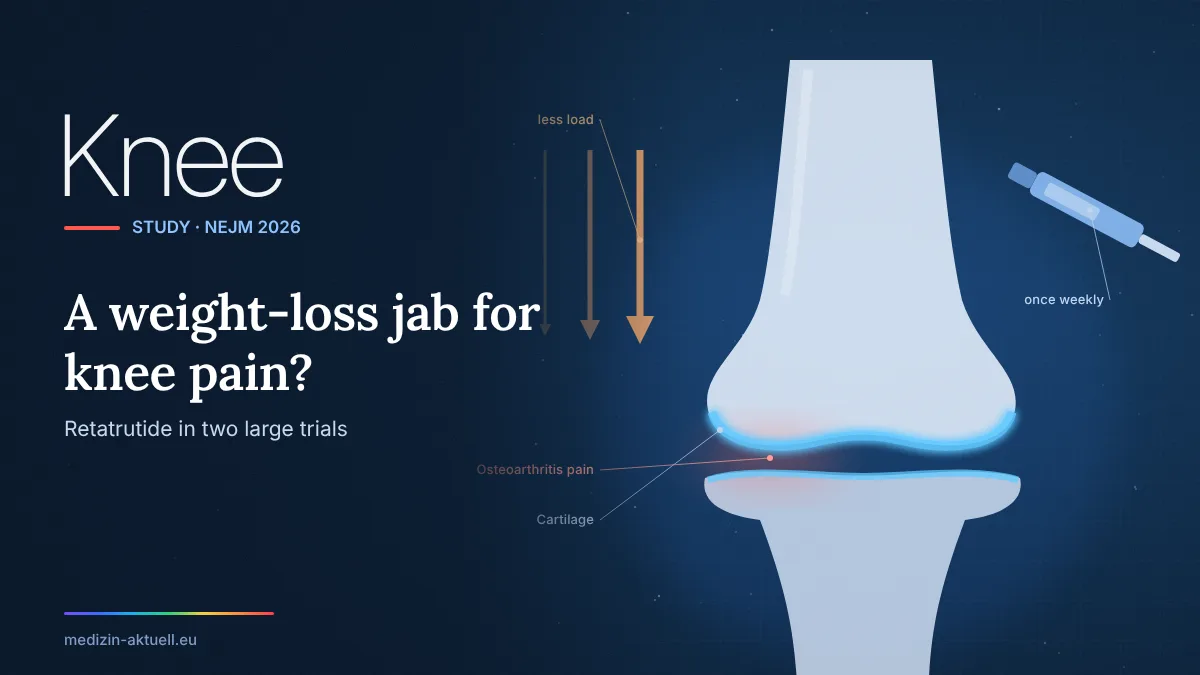
Can a weight-loss drug ease knee pain from osteoarthritis? Two large trials in the New England Journal of Medicine (November 2026) show that people with obesity and knee osteoarthritis lost a lot of weight on the not-yet-approved drug retatrutide – and had less pain than with placebo.
In short: In the TRIUMPH-4 and TRIUMPH-1-OA trials, with more than 1,000 participants combined, knee pain fell more with retatrutide than with placebo, and body weight dropped by around 18 to 25 per cent. Whether the drug slows joint damage was not studied. Retatrutide is not approved; the manufacturer plans to apply for approval in 2027.
Why weight matters so much for the knee
Knee osteoarthritis is one of the most common joint diseases: the cartilage covering the ends of the bones wears down, and the joint becomes painful and stiff. Excess weight is one of the most important modifiable risk factors, because every kilogram acts on the knee several times over when walking or climbing stairs. Guidelines therefore recommend weight loss combined with exercise therapy for people with overweight and knee osteoarthritis. In everyday life, however, substantial and lasting weight loss is often hard to achieve – which is where the new weight-loss drugs come in.
What is retatrutide?
Retatrutide is an investigational drug from the US company Eli Lilly, injected under the skin once a week. It mimics three of the body’s own hormones: GLP-1 and GIP, which are released after eating and help create a feeling of fullness, and glucagon, which affects energy expenditure. Related drugs include semaglutide, which acts only on GLP-1, and tirzepatide, which targets GLP-1 and GIP.
The trials
Both trials were randomised, double-blind and placebo-controlled. Participants were adults with painful knee osteoarthritis and overweight or obesity; around eight in ten had a body mass index above 35.
- TRIUMPH-4: 445 adults without diabetes received 9 mg or 12 mg of retatrutide or placebo once a week for 68 weeks.
- TRIUMPH-1-OA: 574 adults received 4 mg, 9 mg or 12 mg of retatrutide or placebo for 80 weeks.
Knee pain was measured with the WOMAC questionnaire, an established tool for osteoarthritis symptoms, on a scale of 0 to 10. Baseline scores ranged from 4 to 9.
The results
- Pain (TRIUMPH-4, week 68): The pain score fell by an average of 3.96 points with 9 mg, 3.74 points with 12 mg and 2.12 points with placebo – a difference from placebo of about 1.6 to 1.8 points.
- Pain (TRIUMPH-1-OA, week 80): The difference from placebo ranged from 1.35 to 1.77 points depending on the dose.
- Pain halved: In a pooled analysis at week 68, about 63 to 70 per cent on retatrutide had at least 50 per cent less pain, compared with about 38 per cent on placebo.
- Weight: In TRIUMPH-4, participants lost 20.0 per cent (9 mg) and 23.7 per cent (12 mg) of their body weight, versus 4.6 per cent on placebo. In TRIUMPH-1-OA, the figures were 17.5 to 24.8 per cent versus 4.3 per cent.
Notably, pain also fell considerably in the placebo groups. This is typical of pain studies and shows why comparison with placebo is so important.
Side effects and discontinuations
Nausea, diarrhoea and constipation were the most common side effects, mainly while the dose was being increased. In TRIUMPH-4, 12.8 per cent (9 mg) and 18.2 per cent (12 mg) stopped treatment because of adverse events, compared with 4.0 per cent on placebo. Serious adverse events occurred in 9.5 to 10.8 per cent on retatrutide and 2.0 per cent on placebo in TRIUMPH-4. Abnormal skin sensations (dysaesthesia) were also reported more often than with placebo. Overall, only about three in four participants completed treatment as planned.
Putting it into context
The results fit with what is known about weight and the knee: less load can relieve symptoms. Whether retatrutide has an additional effect on the joint, for example on inflammation, is unclear – the mechanism has not been established, and the trials cannot separate how much of the improvement is due to weight loss. The trials measured symptoms and function, not the state of the cartilage, so it remains unknown whether the drug slows joint wear or delays knee replacement. People who already needed a knee replacement were excluded. It is also unknown what happens after stopping treatment.
Important for the assessment: both trials were funded by the manufacturer, which was involved in their design, analysis and manuscript. Independent studies and long-term data are still lacking.
What does this mean for patients?
Retatrutide is not approved in Europe or the US and cannot be prescribed. According to trade press reports, Lilly plans to submit its application in the first quarter of 2027. People with overweight and knee pain can already do a lot: according to guidelines, exercise therapy, strengthening the thigh muscles and weight loss are among the most effective measures. Whether an approved weight-loss medicine is suitable for you is best discussed with your GP or orthopaedic specialist. Retatrutide offered online has not been checked and can be dangerous.
Read more: on a related weight-loss drug, see our article Does semaglutide slow the biological clock?. Background in our encyclopedia: Obesity and Arthritis.
Frequently asked questions
Is retatrutide available?
No. Retatrutide is not approved in the EU or the US and cannot be prescribed. The manufacturer expects to apply for US approval in early 2027. Products offered online have not been checked.
Does losing weight help knee osteoarthritis?
Yes. For people with overweight, weight loss combined with exercise therapy is considered one of the most effective measures against knee pain. Even moderate weight loss can reduce symptoms.
Does retatrutide cure osteoarthritis?
There is no evidence for that. The trials showed less pain and better function but did not examine whether cartilage is protected or knee replacement prevented.
How does it differ from semaglutide and tirzepatide?
Semaglutide acts on one hormone receptor (GLP-1), tirzepatide on two (GLP-1 and GIP) and retatrutide on three (plus glucagon). There are no head-to-head trials in knee osteoarthritis so far.
Note: This article is for general information only and does not replace medical advice. Retatrutide is an unapproved investigational drug.
Sources
- Schnitzer TJ, Hunter DJ, Conaghan PG et al.: Retatrutide Once Weekly in Adults with Knee Osteoarthritis Pain and Obesity. New England Journal of Medicine, 8 November 2026
- Rheum Live: Retatrutide Reduces Knee Osteoarthritis Pain in TRIUMPH-4, TRIUMPH-1-OA (ACR Convergence 2026)
- News-Medical: A weight-loss drug eased knee arthritis pain in two major trials (10 November 2026)
- Pharmacy Times: Lilly prepares for retatrutide FDA filing (July 2026)
- Bannuru RR et al.: OARSI guidelines for the non-surgical management of knee, hip, and polyarticular osteoarthritis. Osteoarthritis and Cartilage 2019
- ClinicalTrials.gov: NCT05931367 (TRIUMPH-4) and NCT05929066 (TRIUMPH-1)


Leave a Reply