Eighteen dermatologists versus four AI chatbots: in a study published in December 2025, both sides were asked to choose the right laser treatment for 25 skin findings. On the basic question of “laser or no laser”, humans and machines were surprisingly close. On the diagnosis, however, the programs were wrong far more often – and they could not name specific laser settings at all. The result shows fairly precisely where artificial intelligence (AI) stands in laser medicine today: promising, but still a long way from autopilot.
This episode opens our four-part series “Lasers & AI”. It gives an overview: where can AI usefully support laser treatment, what has already been tested, and where are the limits? The following parts look more closely at skin diagnostics, eye and stone lasers, and law and data protection. How lasers work in principle is explained on our page How do medical lasers work?.
What “AI” actually means for lasers
Here, AI almost always means machine learning. A computer program is trained on many examples, such as thousands of skin photos with their diagnoses. It then recognises patterns in new images. The program does not “understand” skin. It calculates probabilities based on what it has seen.
One distinction matters: many laser devices have used sensors and fixed control technology for years, for example skin cooling, temperature measurement or scanners that place spots of light in a grid. That is automation, but not learning AI. Marketing copy likes to blur this difference.
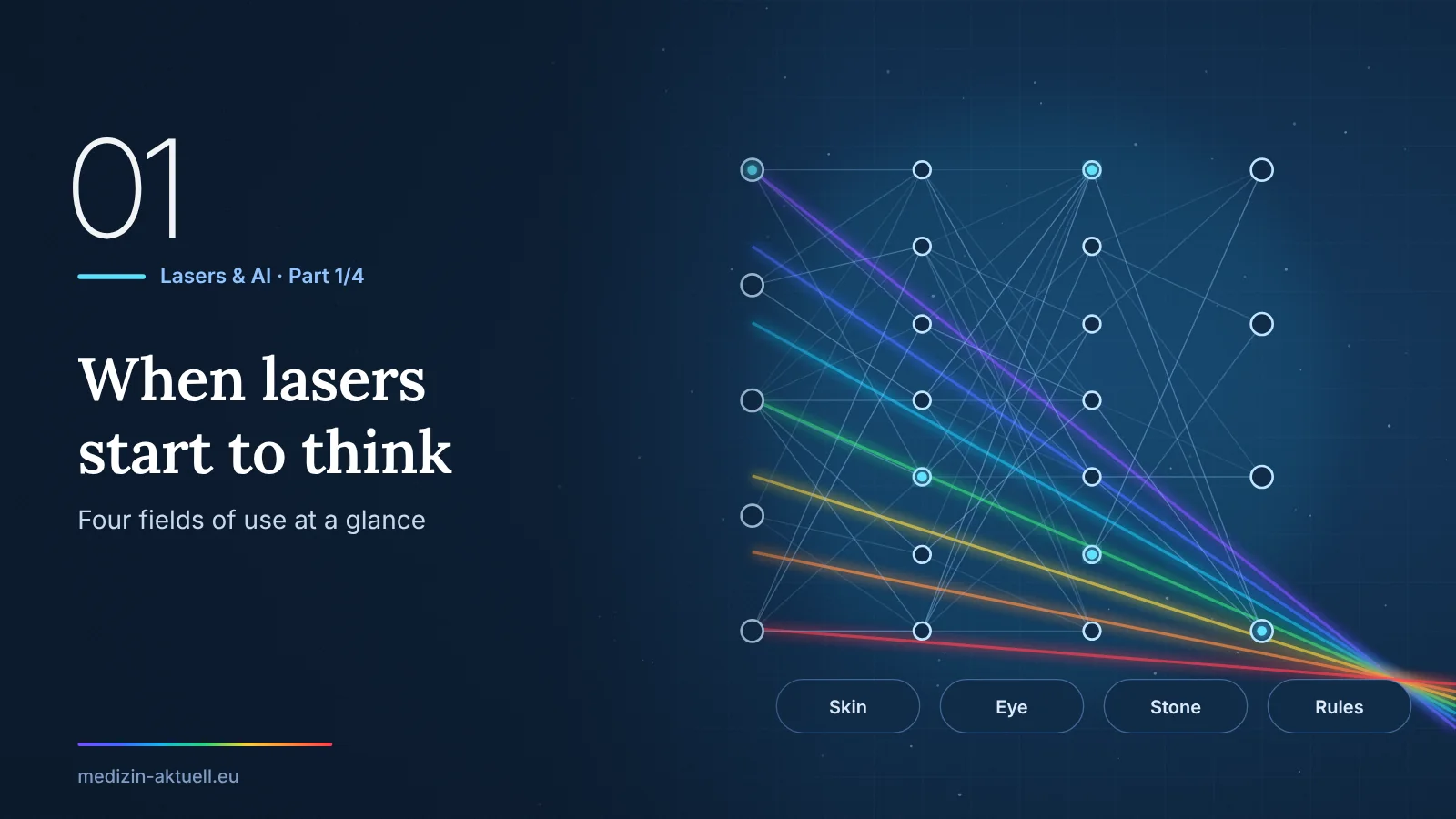
Four areas of use at a glance
1. Recognising skin and findings
Before a laser is used, it must be clear what is being treated and how sensitive the skin is. This is where image-analysis programs come in: they are meant to distinguish pigmented spots, blood vessels or scars and to estimate the Fitzpatrick skin type. Skin type is central to laser medicine because the skin pigment melanin absorbs a lot of laser light. In dark skin, the risk of burns and pigment changes is therefore higher.
This is exactly where a weakness shows: a large research dataset of around 16,500 clinical images labelled by skin type was published in 2021 precisely because darker skin types hardly appear in the usual image collections. A Stanford study showed in 2022 that established skin-cancer models performed considerably worse on a diverse image set, especially on dark skin. More on this in part 2 of the series.
2. Treatment suggestions and settings
The idea sounds tempting: the AI looks at a photo and suggests wavelength, energy and pulse duration. The study by Junge and colleagues (2025/2026) tested general-purpose chatbots on 25 image-based cases. In choosing the type of laser, the programs did not differ significantly overall from 18 dermatologists. But the chatbots’ diagnoses were correct in only 57 per cent of cases, the specialists’ in 75.6 per cent. For rare findings, the programs’ hit rate fell to almost zero. The systems were unable to specify treatment parameters such as wavelength, fluence or pulse duration. The authors explicitly advise against using such tools for diagnostic or laser decisions without medical supervision.
Specialised systems that adjust themselves during treatment are described in review articles as a future prospect. Robust clinical studies are still lacking. A review from 2024 itself calls real-time adaptation “still a challenge”.
3. Analysing images before and after treatment
Whether a port-wine stain becomes lighter or a scar flatter is still mostly judged by eye and from photographs. Standardised photography, image software and methods such as high-frequency ultrasound or optical coherence tomography are meant to make this more objective. AI programs that automatically outline lesions on photos exist in research. A 2024 review on port-wine stains notes, however, that such segmentation networks are not yet widely used to assess treatment success. For patients, this means that comparison photos remain important; an “AI score” is not proof of success.
4. Robotics and automated scanners
Guiding a laser evenly by hand over a large area is difficult. Some spots receive too much energy, others too little. Robotic arms with cameras are meant to help:
- In a Korean study, a robot with a laser distance sensor and camera treated one thigh of each of six men for hair removal, while a doctor treated the other. The robot achieved hair reduction of 49 per cent, the doctors 29.5 per cent. But it needed just over 18 minutes instead of just over three, and the doctors had delivered far fewer pulses.
- A prototype from China and Hong Kong with a 3D camera and temperature sensor treated one half of the face of each of 17 volunteers with a Q-switched Nd:YAG laser. It covered more area (60 versus 44 per cent) but was slower. After one month, skin measurements showed no difference. The work was published as a preprint and was partly funded by a company involved.
- A research system at Duke University coupled a 3D camera with a CO2 laser scalpel. On plastic models, the mean targeting error was below one millimetre.
These are feasibility studies with few participants. The 2025/2026 study mentioned above concludes that a lack of safety data has so far prevented robot-assisted laser treatment from being used in practice.
The limits: data, responsibility, expectations
- Data gaps: models only learn what is in their training data. Rare findings and dark skin types are often under-represented.
- Black box: many models cannot explain why they reach a result. That makes informed consent harder.
- Missing context: a photo does not show previous illnesses, medication, a fresh tan or a tendency to scar. All of this helps determine the right treatment.
- Law: in Germany, the Ordinance on Protection against Non-Ionising Radiation (NiSV) reserves, among other things, ablative laser treatments, the treatment of vascular and pigmented lesions and tattoo removal for licensed physicians with appropriate training. No software changes that. Details on our page Laser safety: who may treat?.
What this means for you
In future, AI may help make laser treatments more even, better documented and safer. Today it is mainly a research topic with individual tools in practice. If a provider advertises an “AI-controlled laser”, you are entitled to ask: what exactly does the software do? Is it approved as a medical device? And who checks the result? Our treatment companion offers guidance for the consultation before treatment.
If you would like to understand how a physics experiment from 1960 became a medical tool, you will find the background in our series “History of the laser”.
Frequently asked questions
Are there already lasers that treat on their own using AI?
In research, there are robotic prototypes that distribute laser pulses automatically. According to current literature, robust safety data for widespread use are lacking. In practice, treatment is controlled by people, who are responsible for it.
Can an app determine my skin type for laser treatment?
Apps can estimate skin type, but their accuracy is uncertain, particularly for dark skin. Skin type should be determined in a medical consultation, often supplemented by a test treatment on a small area.
Is an “AI laser” automatically better?
No. What matters are the correct diagnosis, the right wavelength, the experience of the person treating and good aftercare. Whether software contributes to this has to be demonstrated for each product.
Can I ask an AI chatbot for laser advice?
General information can be helpful. General-purpose chatbots are not suitable for diagnoses and treatment decisions; one study found considerably more misdiagnoses with them than with dermatologists.
Read more: Laser medicine overview · How lasers work · Laser safety: who may treat? · Vascular lasers · Laser scar treatment · Treatment companion
Series “Lasers & AI”: Part 1 (this article) · Part 2: Reading images – AI-assisted diagnosis before laser treatment
General information, not a substitute for medical advice. This article does not advertise any particular device, treatment or provider. Status: November 2026.
Sources
- Junge A. et al.: Artificial Intelligence in Cosmetic Dermatology with Regard to Laser Treatments: A Comparative Analysis of AI and Dermatologists’ Decision-Making. Cosmetics 2026;13(1):5 (online December 2025)
- Haykal D.: Emerging and Pioneering AI Technologies in Aesthetic Dermatology. Cosmetics 2024;11(6):206
- Lim H. W. et al.: Comparison of efficacy between novel robot-assisted laser hair removal and physician-directed hair removal. Photomedicine and Laser Surgery 2015 (PubMed)
- Chan S. U. et al.: A Split-face Study of Novel Robotic Prototype vs Human Operator in Skin Rejuvenation Using Q-switched Nd:YAG Laser. arXiv 2021 (preprint)
- Ma G. et al.: A novel laser scalpel system for computer-assisted laser surgery. IEEE ICRA 2019
- Groh M. et al.: Evaluating Deep Neural Networks Trained on Clinical Images in Dermatology with the Fitzpatrick 17k Dataset. CVPR Workshops 2021
- Daneshjou R. et al.: Disparities in dermatology AI performance on a diverse, curated clinical image set. Science Advances 2022 (preprint version on arXiv)
- Tian R. et al.: Non-invasive efficacy assessment of pulsed dye laser and photodynamic therapy for port-wine stain. Indian J Dermatol Venereol Leprol 2024
- Ordinance on Protection against the Harmful Effects of Non-Ionising Radiation in Applications on Humans (NiSV), section 5 (German)


Leave a Reply