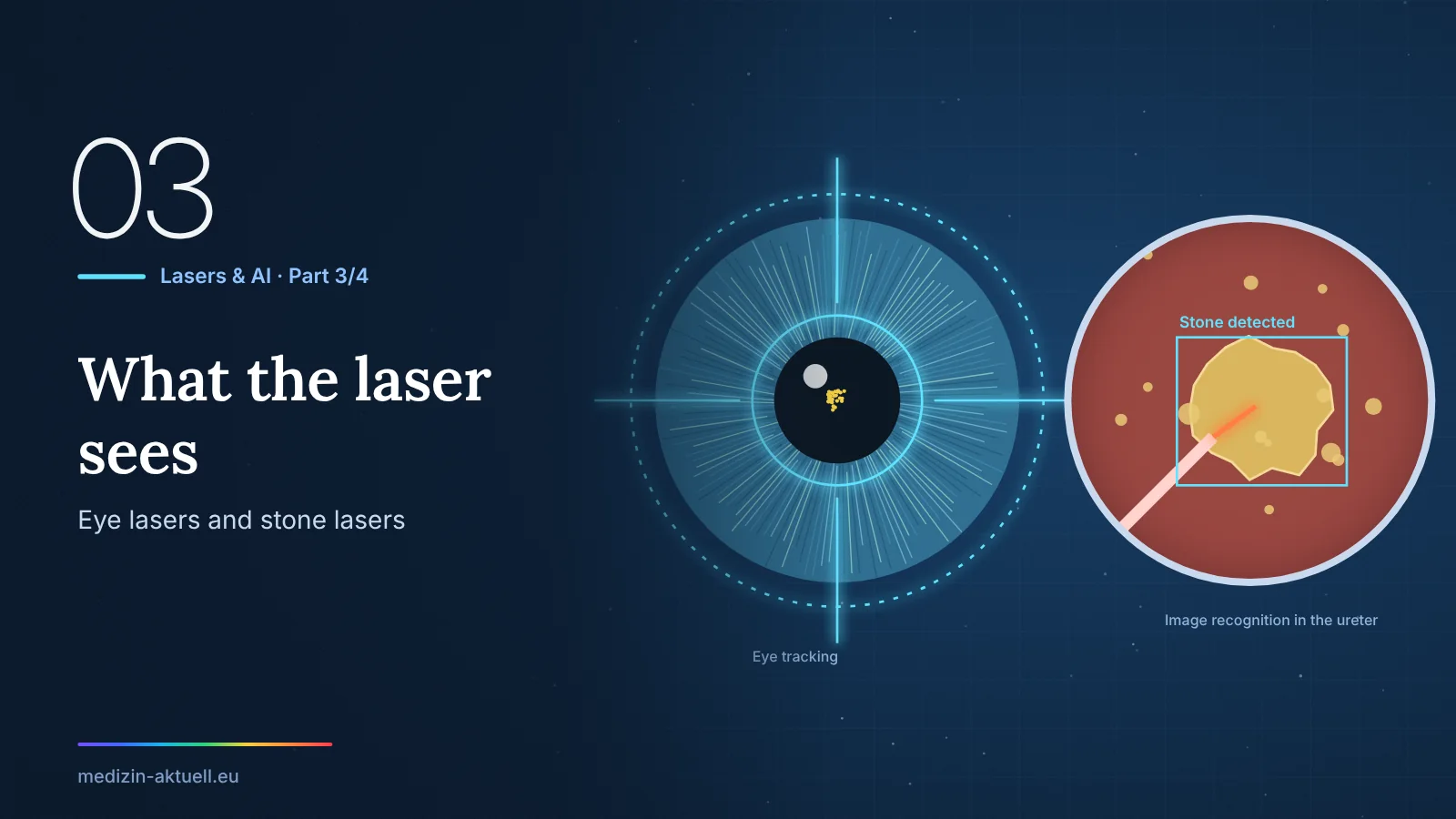
When you lie down for laser eye surgery, your eye rotates slightly around its own axis. You do not notice it. In a study of 392 eyes, the rotation exceeded two degrees in around six out of ten successfully measured eyes – enough to distort the correction of astigmatism. That the laser still works in the right place is thanks to cameras and algorithms. But which of them are really “artificial intelligence”, and what is proven? A sober look at two specialties in which lasers have to be particularly precise: ophthalmology and urology.
This is part 3 of our series “Lasers & AI”. After the overview in part 1 and skin diagnostics in part 2, this part is about specialties in which lasers work to a fraction of a millimetre.
Laser eye surgery: what the laser “sees”
Eye tracking and iris registration – established, mostly not AI
In procedures such as LASIK or PRK, an excimer laser reshapes the cornea. During treatment, an eye tracker follows the eye’s movements with a camera and guides the laser beam accordingly or interrupts it. Before treatment, the device can also match the pattern of the iris against an image taken at the preliminary examination. This makes it possible to compensate for the eye’s rotation when lying down.
A study in Frontiers in Medicine (2026) examined this in 392 eyes undergoing femtosecond LASIK. Rotation when lying down could be registered in 80.6 per cent of eyes, movement during treatment in 98.7 per cent. In 59.5 per cent of successfully measured eyes, the rotation was more than two degrees. This technology is mature and part of everyday clinical practice. It relies mainly on classical image processing. Anyone advertising it as an “AI eye laser” is usually exaggerating.
Preliminary examination: AI against hidden keratoconus
The most important safety risk in laser eye surgery lies before the operation: undetected keratoconus, a progressive thinning and bulging of the cornea. If such a cornea is lasered, it can deform further. AI is being researched intensively here. A Cochrane review from 2023 analysed 63 studies. For manifest keratoconus, AI models reached a sensitivity of 98.6 and a specificity of 98.3 per cent; for early (subclinical) forms, 90.0 and 95.5 per cent. The authors warn, however, that most studies compared selected patients with healthy people. This makes AI appear more accurate than it probably is in everyday practice. They rated the certainty of the evidence as low to very low.
A Korean study (npj Digital Medicine, 2019) trained a model on examination data to identify suitable candidates for corneal laser surgery. In internal validation, accuracy was around 93 per cent. Such tools can alert specialists to abnormalities. Suitability is still determined by the ophthalmologist.
Planning: learning nomograms
How much tissue a laser should remove is planned with formulas and empirical values (nomograms). A study in the American Journal of Ophthalmology (2020) trained a model on 865 particularly successful SMILE treatments by an experienced surgeon. In the comparison, 93 per cent of eyes in the machine-learning group were within 0.5 dioptres of the target, compared with 83 per cent with conventional planning. That is an interesting signal from a single centre, not general proof.
In femtosecond laser-assisted cataract surgery, built-in optical coherence tomography (OCT) shows the cornea, lens and lens capsule in cross-section so that the laser places its incisions correctly. This too is mainly imaging; the surgeon checks and confirms the plan. More on these procedures on our page Laser eye surgery.
Stone lasers: what AI can recognise in the ureter
Kidney and ureteric stones are now often broken up using a thin endoscope (ureteroscopy) and a holmium or thulium laser. How the laser is set also depends on the type of stone. The composition is traditionally determined in the laboratory, but the result only comes after the procedure.
Recognising the stone type on screen
- A US study (BJU International, 2020) trained a neural network on photos of 63 stones of five compositions. Weighted overall, it recognised 85 per cent correctly – uric acid stones 94 per cent, brushite stones only 71 per cent.
- A French study (BJU International, 2022) used images taken directly during surgery. The model recognised pure calcium oxalate monohydrate stones in 91 per cent (surface) and 94 per cent (cross-section) of cases. For mixed stones, both components were recognised in only 65 to 74 per cent. The team itself describes it as a preliminary single-centre study.
Stone or tissue? Feedback for the laser
When visibility is poor, there is a risk of hitting ureteric or kidney tissue. Researchers in Lübeck therefore investigated whether the laser fibre itself can measure whether a stone or tissue lies in front of it – using reflected white light and autofluorescence. Initial measurements in patients served as proof of concept. The goal is automatic feedback that holds back the laser on tissue contact.
What the specialist society says
A systematic review from the Endourology Section of the European Association of Urology (EAU), published in 2025 in the World Journal of Urology, found only six studies on the use of AI during stone treatment. They covered navigation, distinguishing stone from tissue, stone type and size measurement, some of them in animals or kidney models. The conclusion: promising, but without a solid clinical basis; practical benefit remains questionable for lack of validated studies. More on laser therapy in urology on our page Lasers in urology.
How to assess marketing claims
- Automation is not the same as AI: many features of modern lasers, such as eye tracking or adapted pulse shapes, are based on physics, sensors and fixed rules.
- Research is not the same as approval: good results in a study do not mean that a product is approved for that purpose. What a medical device is meant to do is stated in its intended purpose.
- Ask: what role does software play in my treatment, who supervises it, and what data are there on it?
How a laboratory laser from 1960 gave rise to tools for the eye and the ureter is described in our series “History of the laser”.
Frequently asked questions
What happens if my eye twitches during laser eye surgery?
The eye tracker detects the movement and guides the laser accordingly or interrupts it if the deviation is larger. This technology has been standard for years and relies mainly on classical image processing.
Can AI decide whether I can have laser eye surgery?
AI can flag abnormalities such as early keratoconus in corneal images. Suitability is assessed by the ophthalmologist on the basis of all findings and the consultation.
Is my kidney stone already being lasered with AI?
In routine care, generally not. AI for stone recognition and for distinguishing stone from tissue is mostly research. According to a 2025 review, validated clinical studies are lacking.
Why does the stone type matter?
It influences the laser settings and, above all, the prevention of new stones, for example through diet or medication. Laboratory analysis remains the reference.
Read more: Laser medicine overview · Laser eye surgery · Lasers in urology · How lasers work · Treatment companion
Series “Lasers & AI”: Part 2: Reading images – AI-assisted diagnosis before laser treatment · Part 3 (this article) · Part 4: Rules, liability, data protection
General information, not a substitute for medical advice. This article does not advertise any particular device, treatment or provider. Status: November 2026.
Sources
- Ning J. et al.: Distribution of static and dynamic cyclotorsion and influencing factors in FS-LASIK. Frontiers in Medicine 2026
- Vandevenne M. M. S. et al.: Artificial intelligence for detecting keratoconus. Cochrane Database of Systematic Reviews 2023
- Yoo T. K. et al.: Adopting machine learning to automatically identify candidate patients for corneal refractive surgery. npj Digital Medicine 2019
- Cui T. et al.: Applying Machine Learning Techniques in Nomogram Prediction and Analysis for SMILE Treatment. Am J Ophthalmol 2020;210:71–77
- Black K. M. et al.: Deep learning computer vision algorithm for detecting kidney stone composition. BJU Int 2020;125(6):920–924
- Estrade V. et al.: Towards automatic recognition of pure and mixed stones using intra-operative endoscopic digital images. BJU Int 2022;129(2):234–242
- Lange B., Cordes J., Brinkmann R.: Differentiation of tissue and kidney stones for laser lithotripsy using different spectroscopic approaches. Proc. SPIE 2015
- Morozov A. et al.: Intraoperative use of artificial intelligence (AI) during endoscopic lithotripsy: a systematic review from EAU Endourology. World J Urol 2025 (abstract)


Leave a Reply